Prilixor

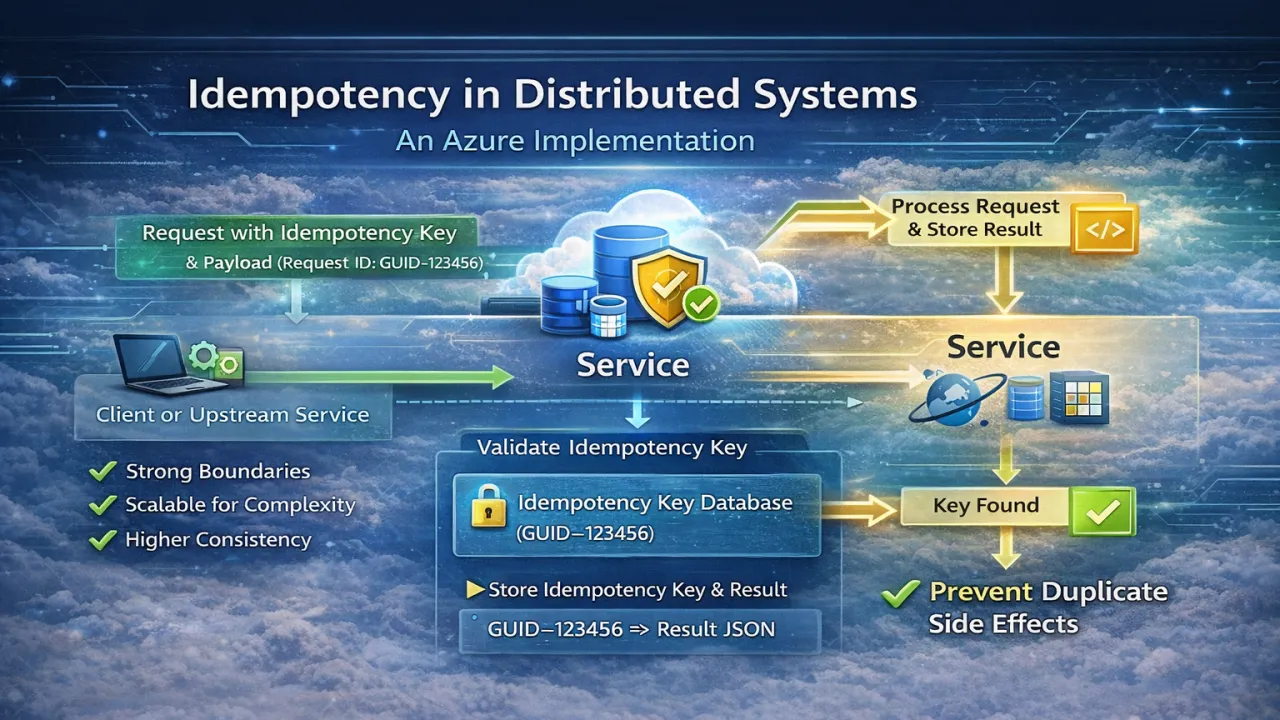
Idempotency in Distributed Systems – A Real Azure Implementation

In distributed systems, duplicate requests are not an edge case—they are inevitable. Network retries, client timeouts, message redelivery, and partial failures all lead to the same operation being executed more than once. Without proper safeguards, these duplicates cause corrupted data, double charges, inconsistent state, and hard-to-debug production incidents.

This is why idempotency is a foundational requirement for reliable distributed systems—especially in Azure-based architectures that rely heavily on retries, messaging, and asynchronous processing.

Why Idempotency Matters in Azure Systems

Azure services are designed for resiliency, not guarantees of single execution. Message queues deliver at least once, APIs may be retried automatically, and clients often resend requests when they don’t receive a response in time. From the platform’s perspective, this is correct behavior. From the application’s perspective, it can be disastrous if operations are not idempotent.

In practical terms, idempotency ensures that performing the same operation multiple times produces the same result as performing it once. The system becomes safe under retries and failures—exactly the conditions distributed systems operate in.

Where Idempotency Is Commonly Required

In real Azure implementations, idempotency is critical in:

  • API endpoints handling commands (payments, orders, registrations)
  • Message consumers processing Service Bus or Event Grid events
  • Background jobs triggered by retries
  • Workflow steps in long-running processes

Any operation that changes state must assume it may run more than once.

A Practical Azure Idempotency Pattern

A common and effective pattern in Azure systems is idempotency keys.

When a client or upstream service sends a request, it includes a unique idempotency key (often a GUID). The service then:

  1. Checks whether the key has already been processed
  2. If yes, returns the previous result
  3. If no, processes the request and stores the result with the key

This record is stored in a durable store such as Azure SQL, Cosmos DB, or Table Storage. The key becomes the source of truth that prevents duplicate side effects.

Idempotency in Messaging Scenarios

Azure Service Bus guarantees at-least-once delivery, not exactly-once processing. This means consumers must assume duplicate messages will arrive.

In production systems, consumers typically:

  • Use the message ID or a business correlation ID
  • Store processed message IDs
  • Ensure side-effects (database writes, external calls) are safe to repeat

The goal is not to stop duplicates—it’s to neutralize their impact.

What Idempotency Is NOT

A common misconception is that idempotency is handled by:

  • Disabling retries
  • Relying on transactions alone
  • Assuming infrastructure guarantees uniqueness

None of these work reliably in distributed systems. Idempotency is an application-level responsibility, not something the platform can fully solve for you.

Trade-offs and Design Considerations

Implementing idempotency introduces its own considerations:

  • Storage overhead for processed keys
  • Cleanup strategies for old records
  • Slight increase in write latency
  • Clear definition of what “same request” means

These trade-offs are minor compared to the cost of corrupted state, customer impact, and emergency fixes.

Final Thoughts

Idempotency is not an optimization—it’s a correctness requirement.

In Azure-based distributed systems, retries, redelivery, and partial failures are normal. Systems that don’t account for this will eventually fail in unpredictable and expensive ways. Systems that embrace idempotency behave calmly under pressure, recover cleanly, and scale safely.

If your system cannot tolerate duplicate execution, it is not production-ready.

Idempotency turns unreliable networks and retries from a liability into a strength—and it’s one of the most practical design decisions you can make in modern Azure architectures.
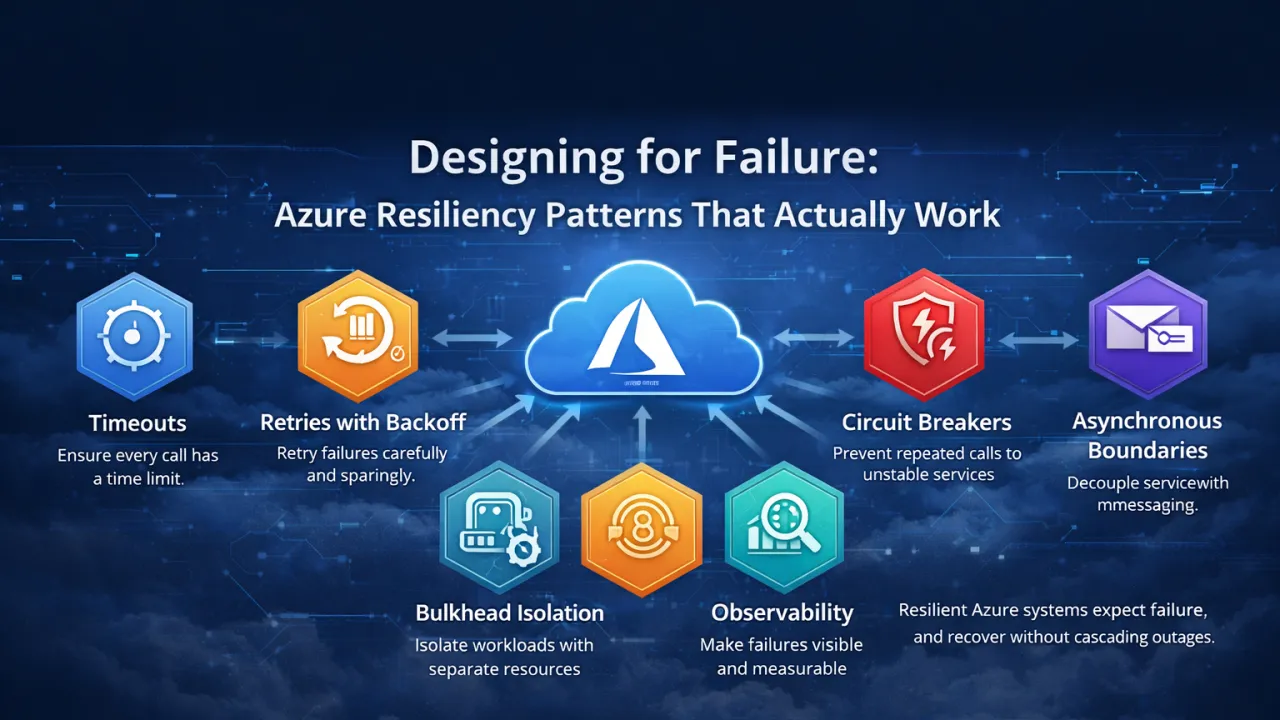
Designing for Failure: Azure Resiliency Patterns That Actually Work

In cloud-native systems, failure is not an exception—it is a certainty. Azure provides highly available infrastructure, but no platform can eliminate network latency, transient faults, throttling, or dependency outages. The real difference between resilient and fragile systems lies in how applications are designed to respond when failures occur. Designing for failure means accepting that components will break and ensuring the system can absorb, isolate, and recover from those failures without cascading impact.

One of the most effective resiliency principles in Azure systems is failing fast with clear boundaries. Timeouts are not optional in distributed systems; they are essential. Without explicit timeouts, slow dependencies silently consume threads and resources until the system collapses under load. Well-designed Azure applications define strict timeout policies and treat delayed responses as failures, allowing the system to recover or degrade gracefully rather than stall indefinitely.

Retries are another powerful but frequently misused resiliency pattern. Blind or aggressive retries often amplify failures instead of resolving them, especially during partial outages. Resilient Azure systems apply retries selectively, using exponential backoff and jitter, and only for operations that are safe to repeat. Combined with circuit breakers, retries become a controlled recovery mechanism rather than a source of cascading failure.

Asynchronous communication is also a cornerstone of resilient design. Synchronous request chains tightly couple services and propagate failures instantly across the system. By introducing asynchronous boundaries—such as messaging or background processing—Azure systems can absorb spikes, decouple dependencies, and continue operating even when downstream services are unavailable. Failures become backlogs to process later, not immediate outages.

Isolation further strengthens resiliency by preventing one failing component from impacting others. Techniques such as bulkhead isolation ensure that critical workloads are protected from less important tasks. In Azure environments, this often means separating resources, queues, or compute for high-priority traffic so that non-essential failures do not degrade the entire system.

Finally, observability is what makes resiliency actionable. Without clear visibility into failures, retries, and degraded behavior, systems fail silently and unpredictably. Resilient Azure systems invest heavily in structured logging, distributed tracing, and meaningful alerts, enabling teams to detect issues early and respond before users are affected.

Designing for failure is not about pessimism—it’s about realism. Azure resiliency patterns work best when they are applied intentionally, consistently, and early in the design process. Systems that embrace failure as a design constraint don’t just survive incidents—they recover quickly, degrade gracefully, and earn long-term trust from both users and operators.

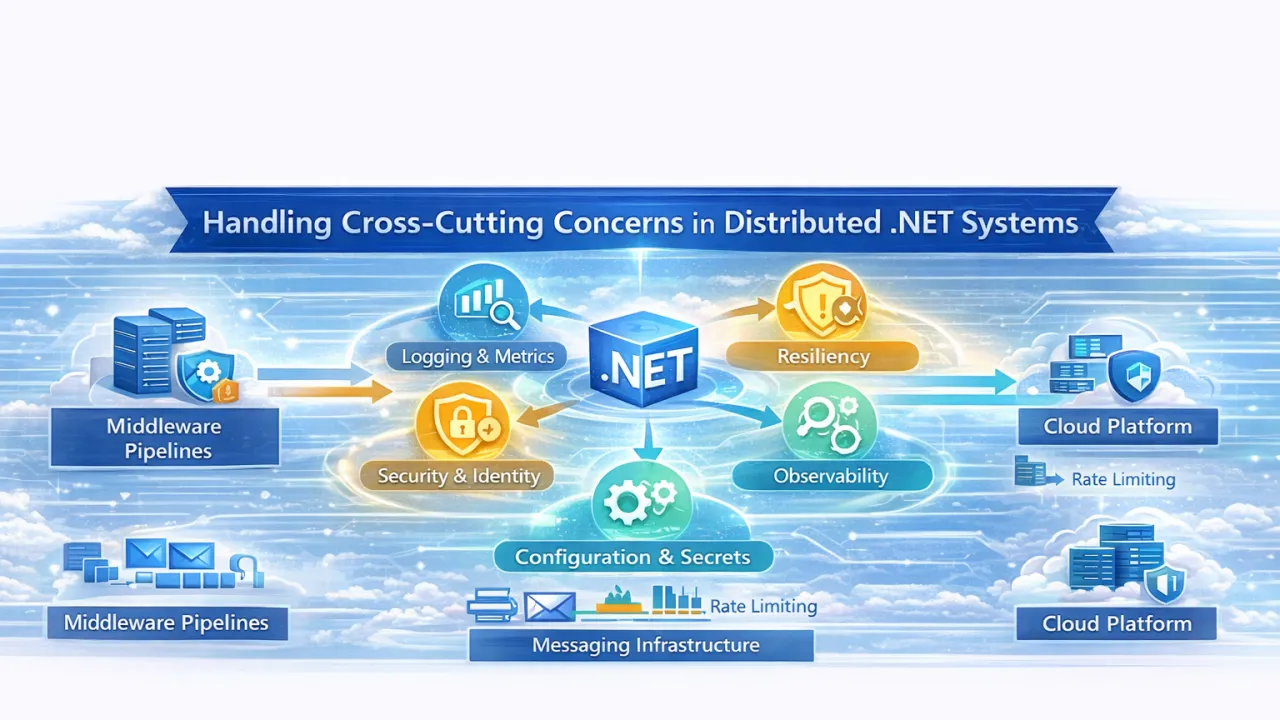
Handling Cross-Cutting Concerns in Distributed .NET Systems

As .NET applications evolve into distributed systems—spanning microservices, APIs, background workers, and serverless components—certain concerns begin to appear everywhere. Logging, security, resiliency, observability, configuration, and error handling cut across every service and every layer.

These are known as cross-cutting concerns, and in distributed systems, handling them poorly is one of the fastest ways to create fragile, inconsistent, and hard-to-operate platforms.

This article explores how to handle cross-cutting concerns effectively in distributed .NET systems, what commonly goes wrong, and which patterns actually work at scale.

🧠 What Are Cross-Cutting Concerns?

Cross-cutting concerns are aspects of a system that:

  • Affect multiple components
  • Are not part of core business logic
  • Must be applied consistently across services

In distributed .NET systems, common cross-cutting concerns include:

  • Logging and monitoring
  • Authentication and authorization
  • Error handling and retries
  • Configuration and secrets
  • Tracing and diagnostics
  • Rate limiting and throttling

The challenge isn’t implementing them—it’s implementing them once, consistently, and correctly across a distributed landscape.

The Most Common Mistake: Handling Them Inside Business Logic

A common failure pattern looks like this:

  • Each service implements its own logging style
  • Retry logic is copy-pasted inconsistently
  • Authentication rules differ per API
  • Errors are handled differently everywhere
  • Configuration is scattered across codebases

This leads to:

  • Inconsistent behavior
  • Security gaps
  • Difficult debugging
  • High maintenance overhead
  • Increased cognitive load for teams

In distributed systems, inconsistency is more dangerous than missing features.

🧩 Principle 1: Push Cross-Cutting Concerns to the Edges

The most effective strategy is to move cross-cutting concerns out of business logic and into shared infrastructure layers.

In .NET systems, this typically means:

  • Middleware pipelines
  • API gateways
  • Messaging infrastructure
  • Platform-level tooling

Business logic should focus on what the system does, not how it logs, retries, or authenticates.

🔐 Security as a Cross-Cutting Concern

Authentication and authorization should be:

  • Centralized
  • Declarative
  • Consistent across services

In distributed .NET systems:

  • APIs should trust validated identities
  • Services should not re-implement auth logic
  • Authorization should be policy-based, not hard-coded

Handling security at the boundary (API gateway, identity provider, platform configuration) reduces duplication and risk.

🔁 Resiliency: Retries, Timeouts, and Circuit Breakers

Failures are normal in distributed systems:

  • Networks fail
  • Services restart
  • Dependencies throttle

Resiliency must be designed, not patched.

Effective .NET systems:

  • Apply retries with exponential backoff
  • Use timeouts consistently
  • Protect dependencies with circuit breakers
  • Avoid retry storms

These behaviors should be standardized—preferably through shared libraries or platform conventions—rather than implemented ad-hoc per service.

📊 Observability: Logging, Metrics, and Tracing

In monoliths, debugging often meant checking logs. In distributed systems, logs alone are not enough.

Effective observability requires:

  • Structured logging
  • Correlation IDs
  • Distributed tracing
  • Consistent metrics

Every request should be traceable across service boundaries. Without this, diagnosing production issues becomes guesswork.

Observability is not a feature—it’s an operational requirement.

Configuration & Secrets Management

Configuration becomes harder as systems scale:

  • Environment differences
  • Secret rotation
  • Service-specific settings

Anti-patterns include:

  • Hard-coded values
  • Secrets in source control
  • Environment-specific code paths

Well-designed .NET systems:

  • Externalize configuration
  • Centralize secrets
  • Treat configuration as data, not code
  • Support dynamic updates where possible

This keeps deployments predictable and secure.

🧠 Principle 2: Prefer Platform Capabilities Over Custom Code

One of the biggest mistakes teams make is re-implementing cross-cutting concerns repeatedly.

In distributed .NET systems, many concerns are better handled by:

  • The hosting platform
  • Shared infrastructure
  • Standardized middleware
  • Proven libraries

Custom implementations increase risk, maintenance cost, and inconsistency—especially as teams and services grow.

Centralization vs Autonomy: Finding the Balance

Not everything should be centralized blindly.

Good rules of thumb:

  • Centralize policies and standards
  • Decentralize business decisions
  • Standardize behavior, not implementation details

Cross-cutting concerns should enable teams—not constrain them.

🏁 Final Thoughts

Handling cross-cutting concerns well is one of the strongest indicators of a mature distributed .NET system.

When done right:

  • Business logic stays clean
  • Services behave consistently
  • Failures are visible and manageable
  • Security is predictable
  • Teams move faster with less risk

When done poorly:

  • Every service becomes a snowflake
  • Debugging turns into archaeology
  • Reliability erodes over time

In distributed systems, architecture isn’t defined by business logic—it’s defined by how cross-cutting concerns are handled.

Treat them as first-class architectural decisions, not implementation details, and your .NET systems will scale not just technically—but operationally and organizationally as well.

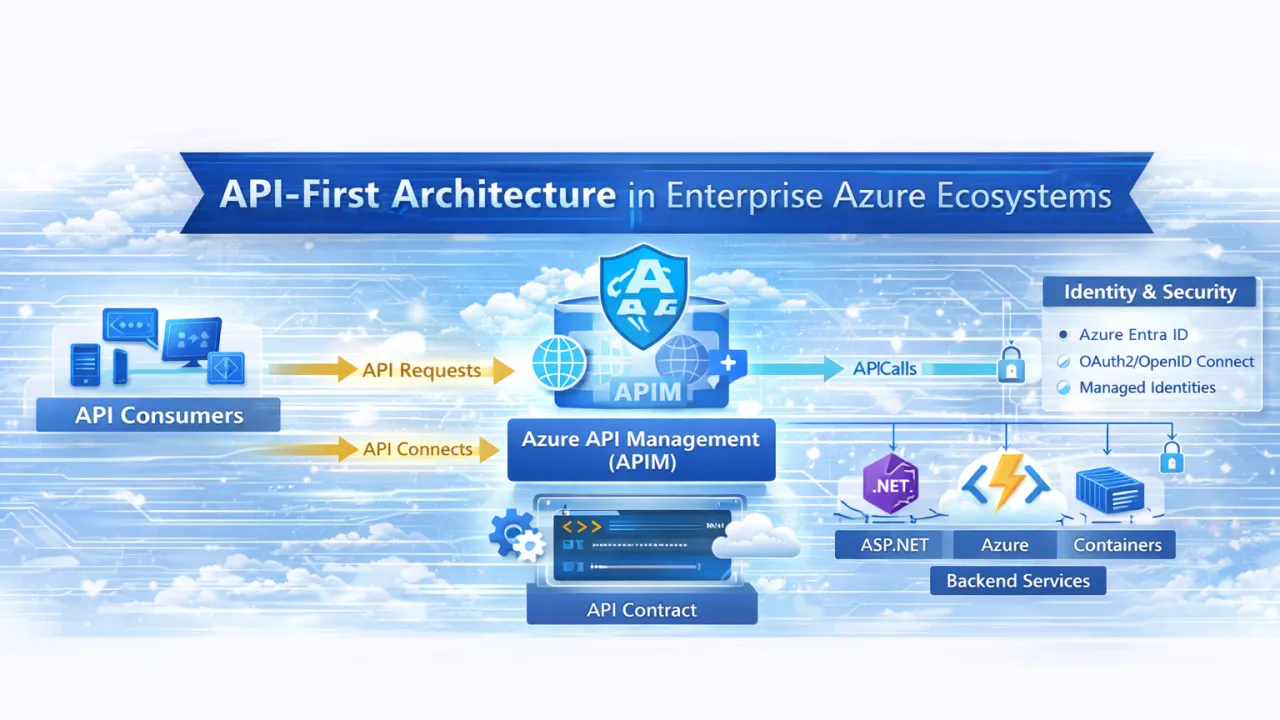
API-First Architecture in Enterprise Azure Ecosystems

In modern enterprise Azure ecosystems, APIs are no longer just technical integration points—they are the primary interface through which systems, teams, and partners interact. As organizations scale, the number of consumers, platforms, and dependencies grows rapidly. Without a clear API strategy, this growth leads to tight coupling, fragile integrations, and slow delivery. API-first architecture addresses this challenge by treating APIs as first-class products rather than implementation by-products.

An API-first approach means designing the API contract before writing any business logic. Instead of exposing internal structures or database models, teams define clear, stable contracts that represent business capabilities. These contracts become the foundation for development, enabling backend services, frontend applications, and external consumers to evolve independently. In large Azure environments, this contract-driven model significantly reduces integration friction and prevents breaking changes from cascading across systems.

One of the biggest advantages of API-first architecture in Azure is organizational scalability. Enterprise platforms often involve multiple teams working in parallel. When APIs are well-designed and governed, teams can build, test, and deploy independently without constantly coordinating changes. Azure API Management (APIM) plays a central role here by acting as the unified entry point for APIs, enforcing security, throttling, versioning, and providing visibility into usage and performance.

Security is another area where API-first architecture proves critical. In enterprise systems, APIs define the boundary of trust. By centralizing authentication and authorization at the API layer—using Azure Entra ID, OAuth 2.0, and managed identities—organizations ensure consistent security policies across all consumers. This avoids the common anti-pattern of duplicating security logic inside every service, which often leads to inconsistencies and vulnerabilities.

API-first architecture also enables safe evolution over time. Enterprise APIs tend to live far longer than individual applications. When APIs are versioned intentionally and treated as long-term commitments, teams can introduce new capabilities without disrupting existing consumers. This stability builds trust across the organization and allows systems to modernize incrementally—whether by introducing microservices, serverless components, or legacy integrations behind the same API surface.

Importantly, API-first does not mean API-only. In mature Azure ecosystems, APIs often work alongside event-driven architectures. APIs handle commands and queries—explicit requests for data or actions—while events communicate outcomes and state changes asynchronously. This combination allows enterprises to build systems that are both predictable and scalable, without overloading APIs with responsibilities they were never meant to handle.

Ultimately, API-first architecture is not a tooling decision—it’s a mindset shift. It requires teams to think beyond their own codebases and consider consumers, longevity, governance, and change as core design concerns. Enterprises that adopt API-first principles on Azure gain more than clean integrations; they build platforms that are easier to scale, safer to evolve, and better aligned with long-term business growth.

In large Azure ecosystems, APIs are not just connectors—they are the architecture.

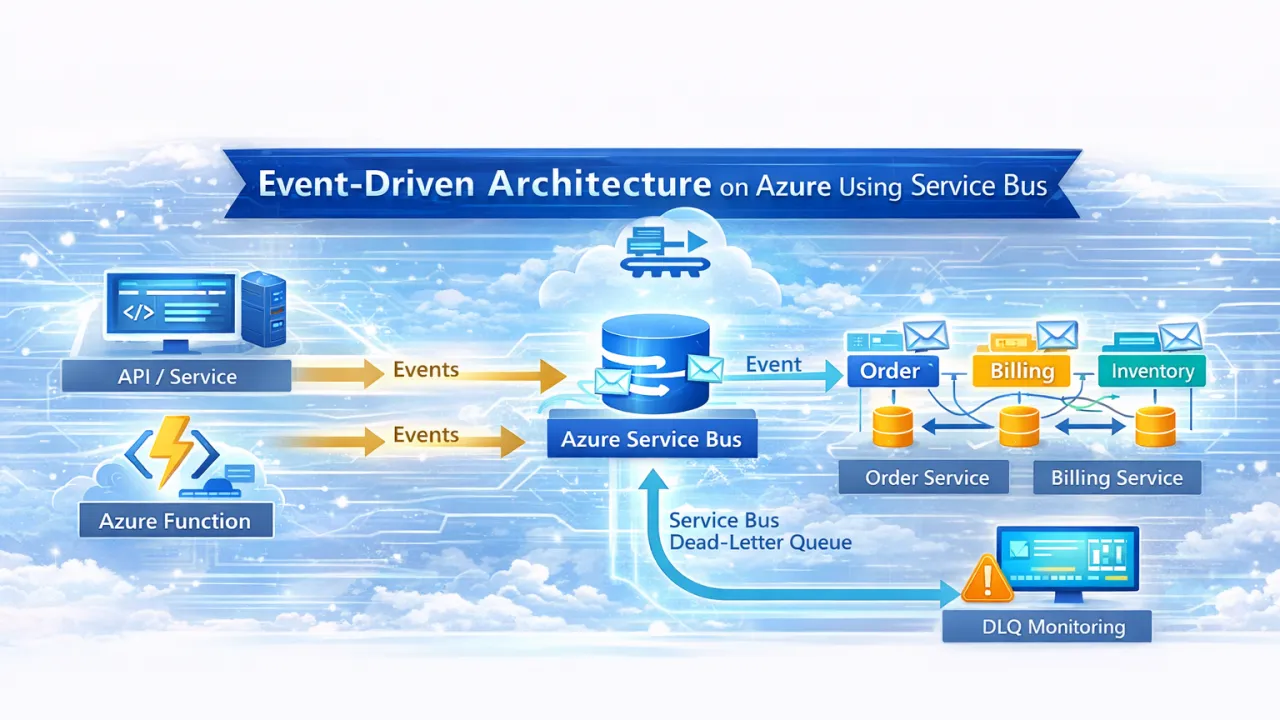
Event-Driven Architecture on Azure Using Service Bus

As systems grow in scale and complexity, tightly coupled, synchronous architectures start to crack. Small failures cascade. Scaling becomes inefficient. Teams slow each other down.

This is where Event-Driven Architecture (EDA) becomes a powerful design choice—and Azure Service Bus is one of the most reliable foundations for building it.

In this article, we explore how to design event-driven systems on Azure using Service Bus, when to use it, common mistakes to avoid, and how it fits into modern .NET and cloud-native architectures.

🧠 What Is Event-Driven Architecture?

Event-Driven Architecture is a model where:

  • Producers emit events (something happened)
  • Consumers react to those events asynchronously
  • Systems are loosely coupled and independently scalable

Instead of asking:

“Can you do this right now?”

Systems say:

“This happened—do what you need, when you’re ready.”

This shift dramatically improves resilience, scalability, and autonomy.

Why Azure Service Bus for Event-Driven Systems?

Azure offers multiple messaging options (Service Bus, Event Grid, Storage Queues). Service Bus is designed for enterprise-grade messaging where reliability and control matter.

Key strengths of Azure Service Bus

  • Guaranteed message delivery
  • At-least-once processing
  • Message ordering (sessions)
  • Dead-letter queues
  • Transactions
  • Fine-grained retry and lock control
  • Secure, private networking support

Service Bus is ideal when:

  • Losing messages is unacceptable
  • Processing is critical to business workflows
  • You need control over retries and failures

🧩 Core Building Blocks of Service Bus

1️ Queues – Point-to-Point Messaging

  • One message → one consumer
  • Ideal for background processing and workflows
  • Natural load leveling

Use cases

  • Order processing
  • Payment handling
  • Job execution
  • Workflow steps

2️ Topics & Subscriptions – Publish/Subscribe

  • One event → multiple subscribers
  • Each consumer gets its own copy
  • Enables system fan-out

Use cases

  • Domain events
  • Integration events
  • Multiple downstream reactions

Example:

OrderPlaced → Billing, Inventory, Notifications, Analytics

3️ Dead-Letter Queues (DLQ)

Messages land in DLQ when:

  • Processing fails repeatedly
  • Validation fails
  • TTL expires

DLQ is not an error—it’s a control mechanism.

Every production system must monitor and handle DLQs intentionally.

🏗 Designing Event-Driven Systems on Azure

🔹 Define Clear Event Contracts

Events should:

  • Represent facts (“OrderPlaced”, not “CreateOrder”)
  • Be immutable
  • Be versioned
  • Avoid leaking internal models

Bad event design is the #1 cause of brittle event systems.

🔹 Prefer Asynchronous Boundaries

Avoid synchronous calls between services when:

  • The consumer doesn’t need immediate feedback
  • Reliability matters more than speed
  • Scaling independently is important

Service Bus introduces temporal decoupling, which improves resilience.

🔹 Design for Idempotency

Service Bus guarantees at-least-once delivery, not exactly-once.

Consumers must safely handle duplicate messages by:

  • Tracking message IDs
  • Using idempotent database operations
  • Designing side-effect-safe handlers

This is non-negotiable in production systems.

Azure Service Bus + .NET (Practical Patterns)

In .NET-based systems, Service Bus is commonly used with:

  • ASP.NET APIs
  • Azure Functions
  • Background worker services
  • Containerized microservices

Common patterns

  • API publishes event → Service Bus topic
  • Background worker processes messages
  • Azure Functions scale consumers automatically
  • Long workflows coordinated with Durable Functions

Service Bus acts as the backbone of asynchronous communication.

Common Mistakes Teams Make

1️ Treating Service Bus Like a Database

Service Bus is not:

  • A data store
  • A replay system
  • A replacement for persistence

Events should be transient signals, not long-term state.

2️ Over-Chattiness

Emitting too many fine-grained events leads to:

  • Noisy systems
  • Hard-to-understand flows
  • Unstable contracts

Prefer meaningful business events, not technical noise.

3️ Ignoring Monitoring & DLQs

Many Azure systems fail quietly because:

  • No DLQ monitoring exists
  • Failed messages pile up unnoticed
  • Teams discover issues days later

Event-driven systems demand strong observability.

🔐 Security & Reliability Considerations

Production-ready Service Bus systems should include:

  • Managed identities (no secrets)
  • Private endpoints where required
  • Retry policies with exponential backoff
  • Circuit breakers on consumers
  • Message size and TTL governance

Reliability is an architectural decision—not a configuration checkbox.

When NOT to Use Service Bus

Service Bus may be the wrong choice when:

  • Events are purely reactive UI notifications → use Event Grid
  • Throughput is extremely high with minimal guarantees → consider Event Hubs
  • Simple, low-critical background jobs → Storage Queues may suffice

Choosing Service Bus means choosing correctness over convenience.

🏁 Final Thoughts

Event-Driven Architecture isn’t about adding messaging—it’s about changing how systems communicate.

Azure Service Bus enables teams to:

  • Decouple services safely
  • Scale independently
  • Build resilient workflows
  • Handle failure gracefully
  • Evolve systems without breaking others

But success requires discipline:

  • Thoughtful event design
  • Strong consumer logic
  • Observability from day one

If microservices are the structure, events are the nervous system.

Used correctly, Azure Service Bus becomes the backbone of reliable, scalable, cloud-native systems.

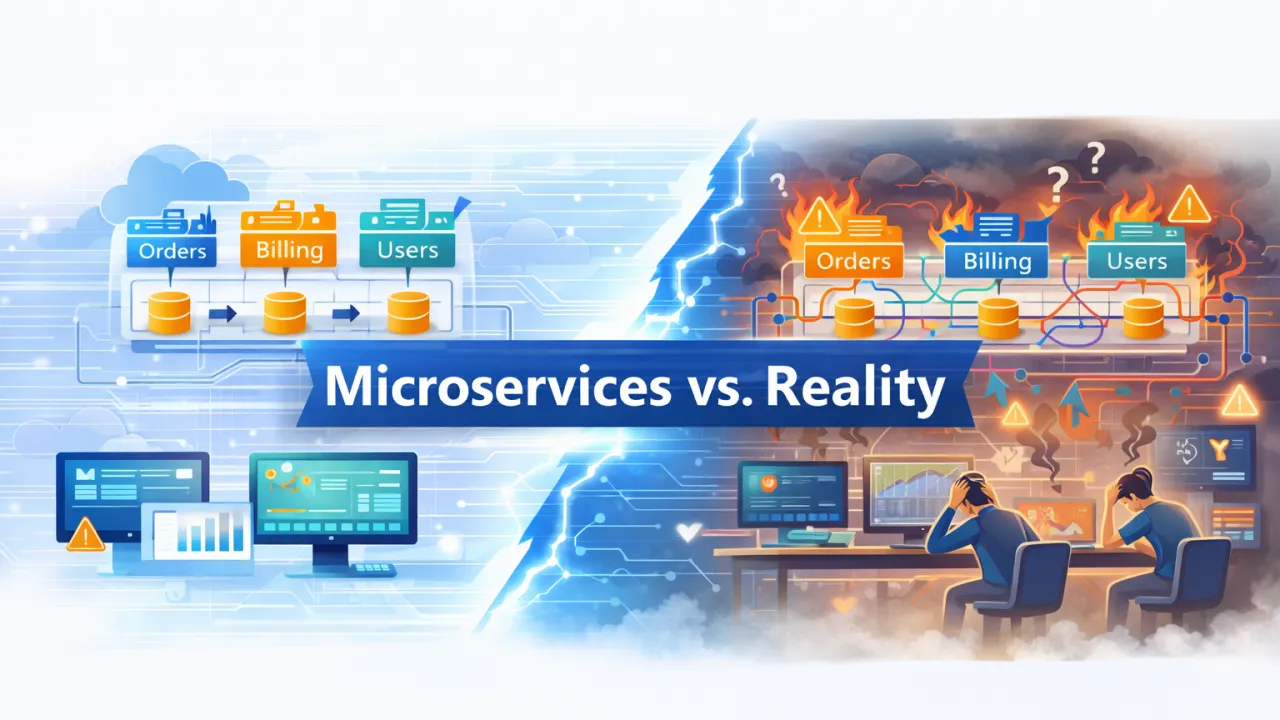
When NOT to Use Microservices (Lessons from Large Azure Systems)

Microservices are often presented as the default architecture for modern cloud systems. Conferences promote them. Blog posts praise them. Architecture diagrams glorify them.

Yet in many large Azure environments, microservices are responsible for slower delivery, higher costs, fragile systems, and exhausted teams.

The problem isn’t microservices themselves—it’s using them when they’re not needed.

This article shares hard-earned lessons from large Azure systems and explains when microservices are the wrong choice, what to use instead, and how to avoid turning your architecture into a distributed problem factory.

🧠 The Core Truth About Microservices

Microservices optimize for:

  • Team autonomy
  • Independent deployment
  • Independent scaling
  • Organizational complexity

They do not optimize for:

  • Simplicity
  • Speed of early development
  • Low operational overhead
  • Small or evolving teams

If your problem doesn’t demand the first set, microservices will punish you with the second.

1. When Your Domain Is Not Clearly Understood

Microservices require stable, well-defined boundaries.

In large Azure systems, the most common failure pattern looks like this:

  • Business rules are still evolving
  • Domain boundaries are unclear
  • Teams guess service boundaries early
  • Changes require constant cross-service refactoring

This leads to:

  • Excessive synchronous calls
  • Chatty APIs
  • Tight coupling over the network
  • Frequent breaking changes

What Works Better

  • Start with a modular monolith
  • Discover boundaries through real usage
  • Refactor internally before distributing externally

If boundaries are unstable inside one codebase, they will be chaos across services.

2. When You Don’t Have Strong DevOps & Observability

Microservices dramatically increase operational surface area:

  • Multiple deployments
  • Distributed failures
  • Network latency
  • Versioning complexity
  • Security boundaries everywhere

In many Azure environments, teams adopt microservices before they have:

  • Centralized logging
  • Distributed tracing
  • Reliable CI/CD
  • Automated rollbacks
  • Alerting discipline

The result? Failures become invisible, debugging becomes guesswork, and teams lose confidence in production.

What Works Better

  • Fewer deployables
  • Centralized monitoring
  • Strong pipelines first
  • Observability before distribution

Microservices multiply both good practices and bad ones.

3. When You Have a Small or Tightly Coupled Team

Microservices shine when:

  • Teams are independent
  • Ownership is clear
  • Communication overhead is manageable

In real Azure projects, many teams are:

  • 3–6 developers
  • Sharing responsibilities
  • Context-switching frequently
  • Supporting production and features simultaneously

In this scenario, microservices create:

  • Coordination overhead
  • More meetings
  • More deployments
  • More failure points

What Works Better

  • Modular monolith
  • Clear internal module ownership
  • Fewer moving parts
  • Faster feedback loops

Microservices optimize for organizational scale, not team size.

4. When You Need Strong Consistency & Transactions

Many enterprise systems require:

  • Strong consistency
  • Multi-step transactions
  • Clear data integrity
  • Predictable workflows

In large Azure systems, microservices introduce:

  • Distributed transactions
  • Eventual consistency
  • Complex compensating logic
  • Difficult edge cases

These problems are architectural, not tooling issues.

What Works Better

  • Single transactional boundary
  • Centralized data ownership
  • Explicit workflows
  • Simpler failure handling

Eventual consistency is powerful—but only when the business can tolerate it.

5. When Cost Predictability Matters

Microservices often increase:

  • Infrastructure costs
  • Networking charges
  • Monitoring overhead
  • Idle compute waste

In Azure, this shows up as:

  • Dozens of underutilized services
  • Complex scaling rules
  • Unexpected egress and messaging costs

For many systems, the ROI simply isn’t there.

What Works Better

  • Fewer services
  • Shared infrastructure
  • Predictable scaling
  • Cost visibility

Cloud-native doesn’t mean cloud-expensive.

6. When You’re Chasing Trends Instead of Solving Problems

One of the most dangerous reasons teams adopt microservices:

“This is how modern systems are built.”

In large Azure systems, this mindset leads to:

  • Over-engineering
  • Architecture for hypothetical scale
  • Premature distribution
  • Fragile systems that are hard to change

A Better Question to Ask

What problem does microservices solve for us right now?

If you can’t answer that clearly, you’re not ready.

Microservices ARE the Right Choice When…

To be clear—microservices do make sense when:

  • You have multiple independent teams
  • Domain boundaries are stable
  • Independent scaling is required
  • Deployment velocity is critical
  • You have strong platform engineering
  • Observability is mature

They are a scaling strategy, not a default architecture.

🏁 Final Thoughts

Large Azure systems don’t fail because microservices are bad. They fail because microservices are used too early, too broadly, and without the necessary maturity.

The most successful teams:

  • Start simple
  • Build strong modular foundations
  • Invest in tooling and observability
  • Let architecture evolve
  • Use microservices intentionally—not emotionally

If microservices don’t remove a real constraint, they will create new ones.

Cloud-native architecture is about clarity, discipline, and trade-offs—not trends.

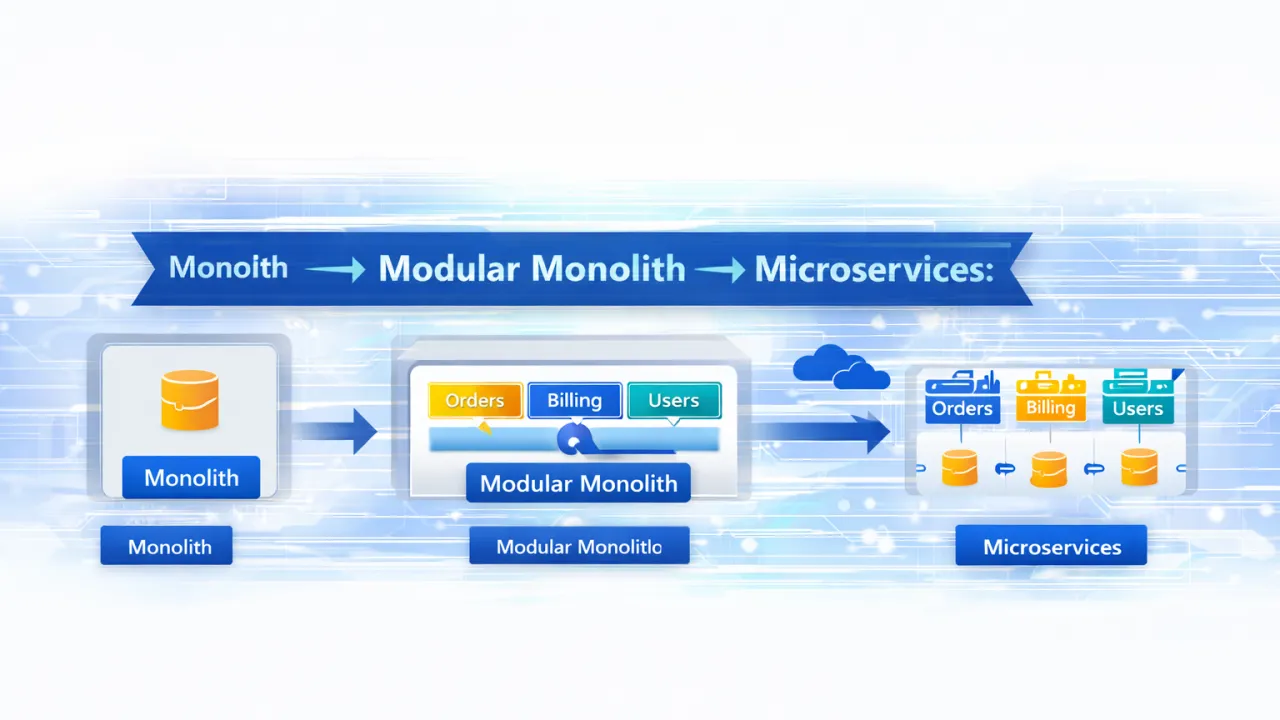
Monolith → Modular Monolith → Microservices: A Practical Azure Journey

Modernizing applications is rarely a straight jump from a legacy monolith to microservices. Yet many teams try to make that leap—and pay the price in complexity, instability, and operational overhead.

The truth is simpler: microservices are an outcome, not a starting point.

This article outlines a practical, Azure-friendly modernization journey that most successful teams follow: Monolith → Modular Monolith → Microservices Each stage has a purpose, benefits, and clear signals for when to move forward.

🧱 Stage 1: The Monolith (Where Most Teams Begin)

A monolithic application is a single deployable unit where:

  • UI, business logic, and data access are tightly coupled
  • Scaling happens as a whole
  • A single failure can impact the entire system

Despite its reputation, the monolith isn’t inherently bad.

Why Monoliths Still Make Sense

  • Simple to develop and deploy early on
  • Easy local debugging
  • Lower operational complexity
  • Faster initial delivery

Where Monoliths Break Down

As systems grow, teams start to feel pain:

  • Small changes require full redeployments
  • Teams step on each other’s code
  • Scaling is inefficient
  • Long release cycles
  • Increasing blast radius of failures

This is usually where teams start thinking about microservices—but jumping straight there is often a mistake.

🧩 Stage 2: The Modular Monolith (The Most Skipped—but Most Important—Step)

A modular monolith is still one deployable application, but internally it is:

  • Logically separated into well-defined modules
  • Enforced by code boundaries, not conventions
  • Designed around business capabilities, not technical layers

This is the most critical phase of the journey.

🔑 Characteristics of a Modular Monolith

  • Clear module boundaries (e.g., Orders, Billing, Users)
  • Each module owns its domain logic
  • Minimal cross-module dependencies
  • Communication via interfaces, not shared data models
  • No direct database access across modules

🧠 Why This Step Matters

If you can’t define clean boundaries inside a monolith, microservices will magnify the problem.

A modular monolith helps teams:

  • Discover true domain boundaries
  • Reduce coupling safely
  • Improve testability
  • Prepare teams for distributed thinking
  • Avoid premature network calls

🛠 Azure-Friendly Implementation

In a .NET + Azure environment:

  • Use solution-level modularization
  • Apply Domain-Driven Design (DDD) concepts
  • Enforce boundaries via assemblies and access rules
  • Centralized deployment (App Service, Container Apps)

At this stage, you gain 80% of the benefits people expect from microservices—with 20% of the complexity.

🚀 Stage 3: Microservices (When—and Only When—it Makes Sense)

Microservices are independently deployable services that:

  • Own their data
  • Scale independently
  • Communicate over the network
  • Are operated and monitored separately

They shine only when the organization and architecture are ready.

Signs You’re Ready for Microservices

  • Stable, well-understood module boundaries
  • Independent teams aligned to business capabilities
  • Clear scaling or reliability needs per module
  • Strong CI/CD practices
  • Observability already in place
  • Operational maturity exists

Common Anti-Patterns

  • Microservices created by technical layers
  • Shared databases across services
  • Excessive synchronous communication
  • Distributed monoliths
  • “Microservices because everyone else does it”

Azure Microservices Stack (Practical, Not Fancy)

  • Azure Container Apps or AKS for services
  • Azure Service Bus / Event Grid for async communication
  • Azure API Management for external access
  • Azure Monitor + Application Insights for observability
  • Managed identities for security

Microservices should simplify scaling and team autonomy, not complicate development.

🔄 Migration Strategy: How to Move Safely

Step-by-Step Approach

  1. Stabilize the monolith
  2. Refactor toward a modular monolith
  3. Enforce boundaries strictly
  4. Extract one module at a time
  5. Start with low-risk, high-value services
  6. Use async messaging to decouple
  7. Measure operational impact continuously

There is no “big bang” migration. Successful teams move incrementally and intentionally.

Trade-Offs to Acknowledge

Microservices introduce:

  • Network latency
  • Operational overhead
  • Deployment complexity
  • Distributed debugging challenges

They are not a free upgrade. They are a trade-off—worth it only when the benefits outweigh the cost.

🏁 Final Thoughts

Modernization is a journey, not a destination.

The most successful Azure teams don’t rush into microservices. They:

  • Start with clarity
  • Build strong modular foundations
  • Let architecture evolve naturally
  • Optimize for team productivity and system resilience

If you remember one thing, let it be this:

If your monolith isn’t modular, your microservices won’t be either.

Cloud-native architecture isn’t about how many services you deploy—it’s about how intentionally you design boundaries.

Designing Cloud-Native Systems with .NET & Azure: What Most Teams Get Wrong

Cloud-native architecture isn’t about lifting existing applications into the cloud—it’s about rethinking how systems are designed, built, deployed, and operated.

Yet many teams migrate their .NET applications to Azure, adopt containers or serverless, enable auto-scaling—and still face issues like poor performance, fragile deployments, unexpected downtime, and rising costs.

The problem isn’t Azure or .NET. It’s that cloud-native principles are often misunderstood or partially applied.

Let’s break down the most common mistakes teams make—and how to design truly cloud-native systems on Azure with .NET.

Mistake 1: Treating Azure Like a Better Data Center

Many teams move their applications to Azure but keep the same:

  • Tight coupling between components
  • Centralized databases
  • Long-running processes
  • Manual scaling assumptions

This results in cloud-hosted systems—but not cloud-native ones.

What Cloud-Native Looks Like

  • Loosely coupled services
  • Stateless compute where possible
  • Externalized state (databases, queues, caches)
  • Designed-for-failure components

Azure isn’t just infrastructure—it’s a distributed application platform.

Mistake 2: Building Stateful APIs and Services

Stateful services create major problems in the cloud:

  • Scaling becomes complex
  • Failures cause data loss or inconsistencies
  • Load balancing is harder

In .NET applications, this often shows up as:

  • In-memory session state
  • Sticky sessions
  • Long-running background tasks inside APIs

The Cloud-Native Approach

  • Keep APIs stateless
  • Store state in Azure SQL, Cosmos DB, Redis, or Blob Storage
  • Use messaging (Service Bus, Event Grid, Storage Queues) for workflows
  • Use Durable Functions when stateful orchestration is required

Stateless services scale cleanly and recover faster.

Mistake 3: Ignoring Failure as a Design Constraint

In the cloud, failure is normal:

  • Instances restart
  • Networks have latency
  • Services throttle or timeout

Many teams assume “high availability” means failures won’t happen.

Design for Failure

Cloud-native .NET systems should include:

  • Retry policies with exponential backoff
  • Circuit breakers
  • Idempotent operations
  • Timeouts and graceful degradation

Azure-native tools like Application Insights and Polly exist for a reason—use them intentionally.

Mistake 4: Overusing Containers for Everything

Containers are powerful—but they’re not always the best choice.

Teams often containerize:

  • Simple background jobs
  • Event-driven workflows
  • Lightweight APIs

This increases operational overhead unnecessarily.

Choose the Right Compute Model

  • Azure Functions → Event-driven, short-lived, scalable workloads
  • Azure Container Apps → Long-running services, APIs, microservices
  • App Service → Simpler web apps with minimal orchestration needs

Cloud-native design is about fit-for-purpose compute, not trends.

Mistake 5: Treating Scalability as an Afterthought

Auto-scaling doesn’t fix poor design.

Common symptoms:

  • Databases becoming bottlenecks
  • Synchronous calls everywhere
  • Chatty service communication

Design for Scale from Day One

  • Use asynchronous messaging
  • Apply backpressure
  • Cache aggressively where appropriate
  • Scale reads separately from writes

Azure scales infrastructure easily—but architecture determines whether scaling works.

Mistake 6: Observability Added Too Late

Many teams add monitoring only after production issues appear.

Without observability, you can’t:

  • Diagnose latency issues
  • Understand failures
  • Optimize costs

Observability Is Part of Architecture

Cloud-native systems should include:

  • Distributed tracing
  • Structured logging
  • Metrics-driven alerts
  • Health probes and readiness checks

Application Insights and Azure Monitor should be first-class citizens, not add-ons.

🏁 Final Thoughts

Designing cloud-native systems with .NET and Azure isn’t about using the latest services—it’s about adopting the right mindset.

Teams struggle not because Azure is complex, but because cloud-native architecture:

  • Challenges traditional design assumptions
  • Forces distributed-systems thinking
  • Requires intentional trade-offs

When done right, cloud-native .NET systems are:

  • Resilient by design
  • Scalable without drama
  • Easier to evolve and maintain
  • More cost-efficient over time

Cloud-native isn’t a checkbox—it’s an architectural discipline.

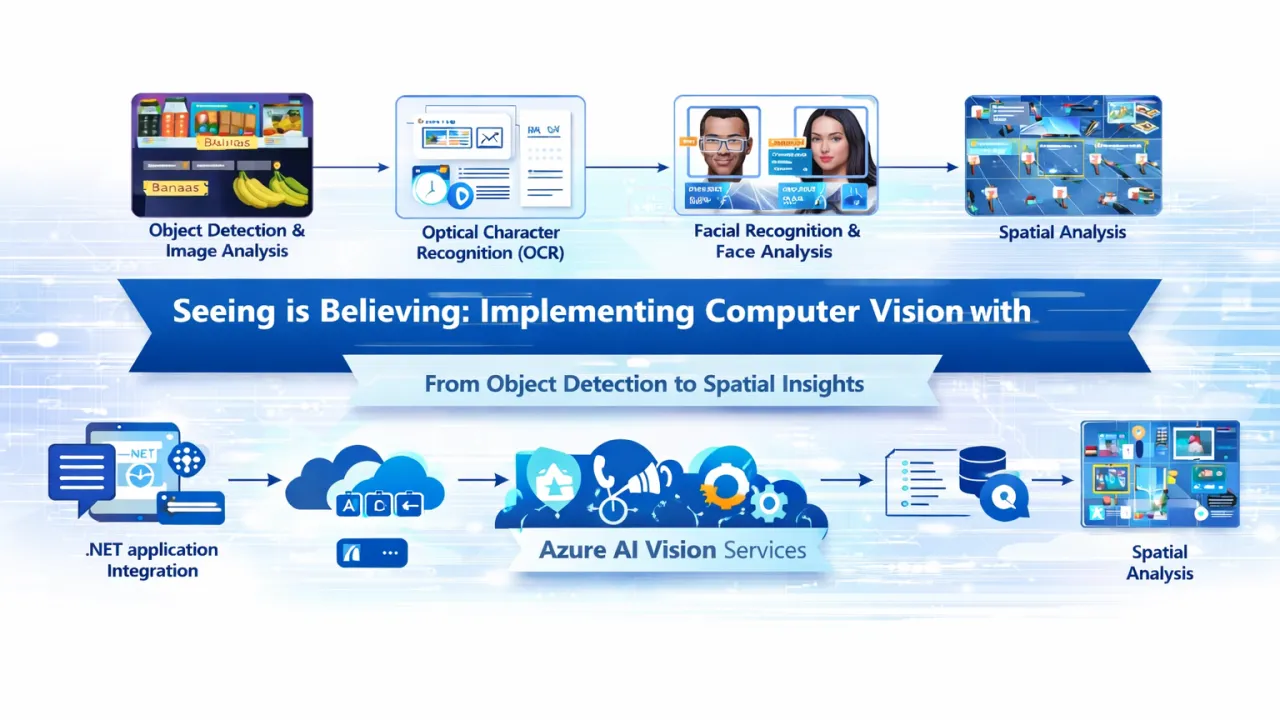
Seeing Is Believing: Implementing Computer Vision with Azure AI in .NET

Computer vision has moved from experimental labs into everyday applications—powering automation, improving user experiences, and unlocking insights from visual data. With Azure AI Vision services from Microsoft Azure, .NET developers can easily bring advanced image and video understanding into real-world systems without building complex ML models from scratch.

This article explores practical computer vision scenarios and shows how .NET teams can integrate Azure AI Vision capabilities—such as object detection, facial recognition, OCR, image analysis, and spatial analysis—into production-ready applications.

🧠 Why Azure AI Vision for .NET Developers?

Azure AI Vision provides pre-trained, enterprise-grade models accessible through simple SDKs and REST APIs. For .NET developers, this means:

  • Seamless integration with ASP.NET, APIs, desktop, and cloud apps
  • No need for deep ML expertise
  • Secure, scalable, and production-ready services
  • Pay-as-you-go pricing aligned with real usage

👁️ Object Detection & Image Analysis

What it does

  • Detects common objects (people, vehicles, products, animals)
  • Analyzes scenes, tags, colors, and image content
  • Identifies unsafe or restricted visual content

Real-world use cases

  • Retail apps detecting products on shelves
  • Manufacturing systems identifying defects
  • Smart city solutions monitoring traffic and crowd density

.NET integration example (conceptual)

  • Upload or stream an image from a web or API request
  • Call Azure AI Vision SDK from a .NET service
  • Parse detected objects and confidence scores
  • Store or act on results in business workflows

🧾 Optical Character Recognition (OCR)

What it does

  • Extracts printed and handwritten text from images and PDFs
  • Supports multiple languages and document formats
  • Preserves layout, tables, and line structure

Real-world use cases

  • Invoice and receipt processing
  • ID and document verification
  • Digitizing forms and handwritten notes

Example scenario

A .NET-based finance system automatically extracts invoice numbers, totals, and dates from uploaded scans—eliminating manual data entry and reducing errors.

🙂 Facial Recognition & Face Analysis

What it does

  • Detects faces and facial landmarks
  • Analyzes attributes such as age range, emotion, and presence
  • Supports identity verification (with responsible AI controls)

Real-world use cases

  • Secure access control systems
  • User verification in onboarding flows
  • Personalized digital experiences

⚠️ Important: Facial recognition must be implemented responsibly, following regional compliance and ethical AI guidelines.

📐 Spatial Analysis (Vision at Scale)

What it does

  • Analyzes video streams in real time
  • Tracks movement, presence, and interactions in physical spaces
  • Detects patterns across defined zones

Real-world use cases

  • Retail footfall analytics
  • Workplace safety monitoring
  • Smart building occupancy insights

Example scenario

A .NET-powered dashboard visualizes real-time occupancy trends in a commercial space using spatial analysis data from connected cameras.

🔗 Integrating Azure AI Vision into .NET Applications

A typical architecture looks like this:

  1. .NET application (ASP.NET API, Web App, or Background Service)
  2. Azure AI Vision SDK or REST API call
  3. Secure authentication using Azure identity
  4. Process results (JSON response)
  5. Store insights in databases or trigger business logic

This modular approach allows vision capabilities to be reused across multiple applications and services.

📊 Monitoring, Scaling, and Optimization

Azure AI Vision services are built for enterprise workloads:

  • Automatic scaling with demand
  • Integrated logging and telemetry
  • Performance monitoring through Azure tools
  • Continuous model improvements without code changes

🏁 Final Thoughts

Computer vision is no longer a niche capability—it’s a competitive advantage. With Azure AI Vision services, .NET developers can rapidly build applications that see, understand, and react to visual information in real time.

From document processing and facial analysis to object detection and spatial insights, Azure AI Vision empowers teams to turn images and video into actionable intelligence—securely, responsibly, and at scale.

In modern applications, seeing truly is believing—and with Azure AI and .NET, it’s also achievable.

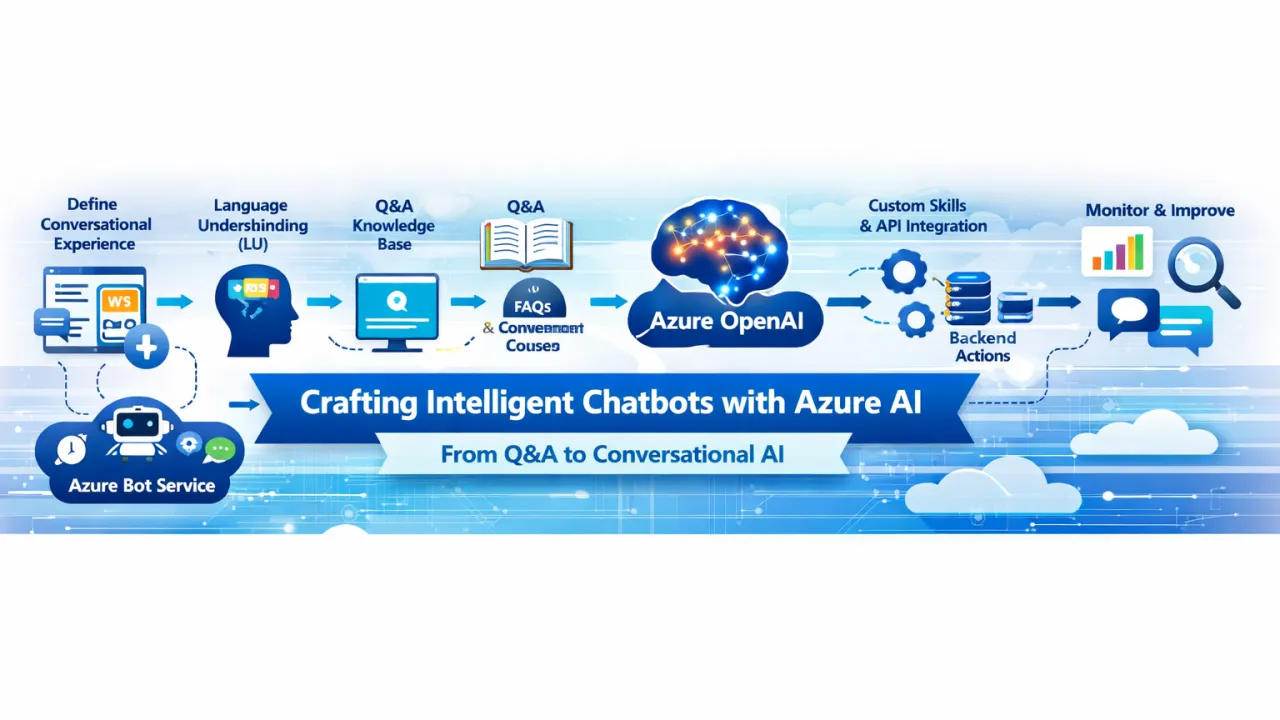
Crafting Intelligent Chatbots with Azure AI: From Simple Q&A to Conversational Intelligence

Chatbots have evolved far beyond static question-and-answer systems. Today’s users expect natural conversations, contextual understanding, personalization, and intelligent responses—across channels and at scale. Azure AI provides a comprehensive ecosystem to build such sophisticated conversational experiences, from basic FAQs to enterprise-grade virtual assistants.

This guide walks through the end-to-end process of building intelligent chatbots using Azure AI, highlighting how multiple services work together to deliver responsive, human-like interactions.

🧠 Step 1: Define the Conversational Experience

Before choosing tools, it’s critical to define:

  • Purpose – Customer support, internal helpdesk, sales assistant, or task automation
  • Channels – Web chat, Microsoft Teams, mobile apps, voice assistants
  • Complexity – FAQ-based, intent-driven, or multi-turn conversational workflows

This clarity ensures the architecture aligns with business and user expectations.

🤖 Step 2: Core Bot Framework with Azure Bot Service

At the heart of the solution is Azure Bot Service, which acts as the orchestration layer for all conversational interactions. It:

  • Manages conversations and sessions
  • Connects to multiple channels
  • Routes user input to the appropriate AI services

The bot itself can be built using familiar languages such as C# or JavaScript and deployed seamlessly to the cloud.

🗣️ Step 3: Natural Language Understanding (NLU)

To move beyond keyword matching, chatbots must understand user intent and context.

Language Understanding (LU)

  • Extracts intents (what the user wants to do)
  • Identifies entities (dates, locations, product names, IDs)
  • Supports multi-turn conversations by tracking context

Example: A user asks, “Can I reschedule my delivery to next Friday?” The bot understands:

  • Intent: Reschedule delivery
  • Entity: Date = next Friday

This enables precise and relevant responses.

📚 Step 4: Knowledge-Based Answers with Q&A Capabilities

For FAQ-style interactions, Azure’s Q&A capabilities allow bots to:

  • Answer questions from structured knowledge bases
  • Pull responses from documents, PDFs, or web content
  • Provide fast, consistent answers without custom logic

This is ideal for:

  • Policy questions
  • Product documentation
  • Internal knowledge portals

🧩 Step 5: Intelligent Conversations with Azure OpenAI

To create truly natural and engaging conversations, Azure OpenAI adds generative intelligence to the chatbot.

Key capabilities:

  • Human-like, free-form responses
  • Context-aware dialogue across multiple turns
  • Summarization, reasoning, and content generation
  • Dynamic handling of unstructured or unexpected queries

This transforms chatbots from scripted responders into adaptive conversational agents.

🔧 Step 6: Extending Capabilities with Custom Skills

Enterprise chatbots often need to take action, not just talk.

Custom skills allow the bot to:

  • Call APIs and backend systems
  • Trigger workflows (orders, tickets, approvals)
  • Integrate with CRM, ERP, or internal tools
  • Execute business logic securely

Example: A chatbot that checks order status, updates customer details, or books appointments in real time.

🔄 Step 7: Context Management & Orchestration

By combining:

  • Azure Bot Service for conversation flow
  • Language Understanding for intent recognition
  • Q&A for factual answers
  • Azure OpenAI for generative dialogue
  • Custom skills for business actions

You can build multi-turn, context-aware conversational experiences that feel seamless and intelligent.

📊 Step 8: Monitoring, Learning, and Continuous Improvement

Production-ready chatbots require ongoing optimization:

  • Conversation analytics and telemetry
  • Intent accuracy monitoring
  • Feedback loops for retraining models
  • Performance and latency tracking

Azure provides built-in monitoring tools to ensure bots improve over time.

🏁 Final Thoughts

Building intelligent chatbots is no longer about choosing a single AI service—it’s about orchestrating multiple AI capabilities into a cohesive conversational system. With Azure AI, teams can evolve from simple Q&A bots to enterprise-grade conversational platforms that understand intent, maintain context, integrate with business systems, and respond naturally.

By leveraging Azure Bot Service, natural language understanding, knowledge-based responses, generative AI, and custom skills—organizations can deliver chatbots that don’t just answer questions, but solve problems and enhance user experiences.

In the era of AI-driven interaction, great chatbots aren’t scripted—they’re intelligent, adaptive, and context-aware.