

Cloud-native architecture isn’t about lifting existing applications into the cloud—it’s about rethinking how systems are designed, built, deployed, and operated.
Yet many teams migrate their .NET applications to Azure, adopt containers or serverless, enable auto-scaling—and still face issues like poor performance, fragile deployments, unexpected downtime, and rising costs.
The problem isn’t Azure or .NET. It’s that cloud-native principles are often misunderstood or partially applied.
Let’s break down the most common mistakes teams make—and how to design truly cloud-native systems on Azure with .NET.
❌ Mistake 1: Treating Azure Like a Better Data Center
Many teams move their applications to Azure but keep the same:
- Tight coupling between components
- Centralized databases
- Long-running processes
- Manual scaling assumptions
This results in cloud-hosted systems—but not cloud-native ones.
✅ What Cloud-Native Looks Like
- Loosely coupled services
- Stateless compute where possible
- Externalized state (databases, queues, caches)
- Designed-for-failure components
Azure isn’t just infrastructure—it’s a distributed application platform.
❌ Mistake 2: Building Stateful APIs and Services
Stateful services create major problems in the cloud:
- Scaling becomes complex
- Failures cause data loss or inconsistencies
- Load balancing is harder
In .NET applications, this often shows up as:
- In-memory session state
- Sticky sessions
- Long-running background tasks inside APIs
✅ The Cloud-Native Approach
- Keep APIs stateless
- Store state in Azure SQL, Cosmos DB, Redis, or Blob Storage
- Use messaging (Service Bus, Event Grid, Storage Queues) for workflows
- Use Durable Functions when stateful orchestration is required
Stateless services scale cleanly and recover faster.
❌ Mistake 3: Ignoring Failure as a Design Constraint
In the cloud, failure is normal:
- Instances restart
- Networks have latency
- Services throttle or timeout
Many teams assume “high availability” means failures won’t happen.
✅ Design for Failure
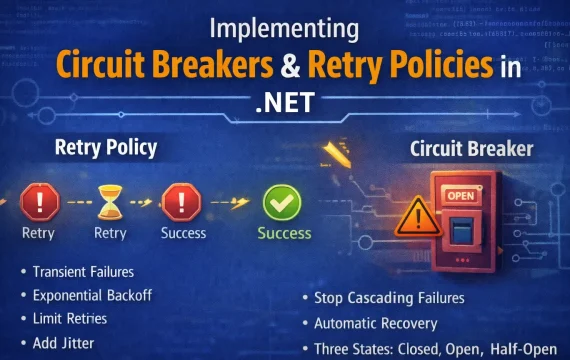
Cloud-native .NET systems should include:
- Retry policies with exponential backoff
- Circuit breakers
- Idempotent operations
- Timeouts and graceful degradation
Azure-native tools like Application Insights and Polly exist for a reason—use them intentionally.
❌ Mistake 4: Overusing Containers for Everything
Containers are powerful—but they’re not always the best choice.
Teams often containerize:
- Simple background jobs
- Event-driven workflows
- Lightweight APIs
This increases operational overhead unnecessarily.
✅ Choose the Right Compute Model
- Azure Functions → Event-driven, short-lived, scalable workloads
- Azure Container Apps → Long-running services, APIs, microservices
- App Service → Simpler web apps with minimal orchestration needs
Cloud-native design is about fit-for-purpose compute, not trends.
❌ Mistake 5: Treating Scalability as an Afterthought
Auto-scaling doesn’t fix poor design.
Common symptoms:
- Databases becoming bottlenecks
- Synchronous calls everywhere
- Chatty service communication
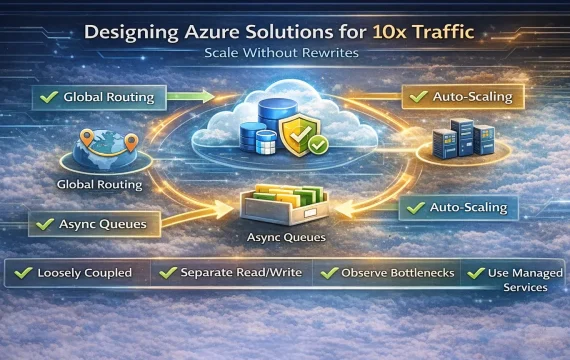
✅ Design for Scale from Day One
- Use asynchronous messaging
- Apply backpressure
- Cache aggressively where appropriate
- Scale reads separately from writes
Azure scales infrastructure easily—but architecture determines whether scaling works.
❌ Mistake 6: Observability Added Too Late
Many teams add monitoring only after production issues appear.
Without observability, you can’t:
- Diagnose latency issues
- Understand failures
- Optimize costs
✅ Observability Is Part of Architecture
Cloud-native systems should include:
- Distributed tracing
- Structured logging
- Metrics-driven alerts
- Health probes and readiness checks
Application Insights and Azure Monitor should be first-class citizens, not add-ons.
🏁 Final Thoughts
Designing cloud-native systems with .NET and Azure isn’t about using the latest services—it’s about adopting the right mindset.
Teams struggle not because Azure is complex, but because cloud-native architecture:
- Challenges traditional design assumptions
- Forces distributed-systems thinking
- Requires intentional trade-offs
When done right, cloud-native .NET systems are:
- Resilient by design
- Scalable without drama
- Easier to evolve and maintain
- More cost-efficient over time
Cloud-native isn’t a checkbox—it’s an architectural discipline.