

As .NET applications evolve into distributed systems—spanning microservices, APIs, background workers, and serverless components—certain concerns begin to appear everywhere. Logging, security, resiliency, observability, configuration, and error handling cut across every service and every layer.
These are known as cross-cutting concerns, and in distributed systems, handling them poorly is one of the fastest ways to create fragile, inconsistent, and hard-to-operate platforms.
This article explores how to handle cross-cutting concerns effectively in distributed .NET systems, what commonly goes wrong, and which patterns actually work at scale.
🧠 What Are Cross-Cutting Concerns?
Cross-cutting concerns are aspects of a system that:
- Affect multiple components
- Are not part of core business logic
- Must be applied consistently across services
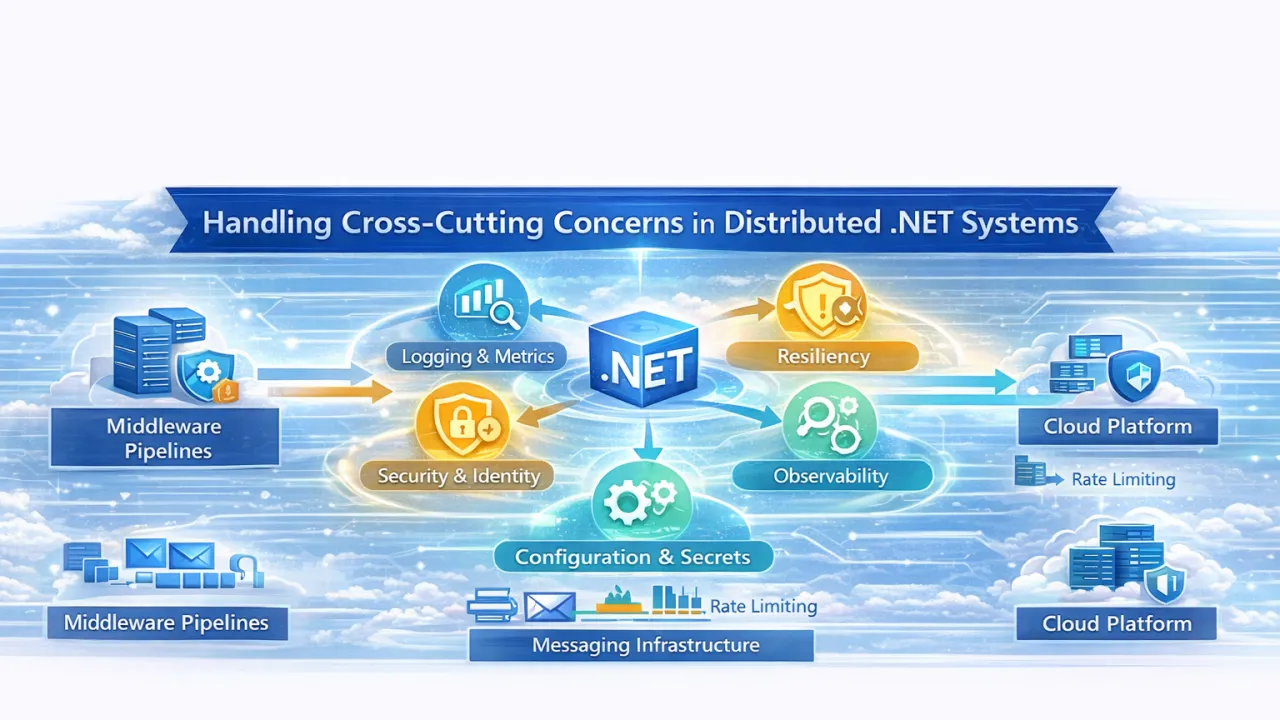
In distributed .NET systems, common cross-cutting concerns include:
- Logging and monitoring
- Authentication and authorization
- Error handling and retries
- Configuration and secrets
- Tracing and diagnostics
- Rate limiting and throttling
The challenge isn’t implementing them—it’s implementing them once, consistently, and correctly across a distributed landscape.
❌ The Most Common Mistake: Handling Them Inside Business Logic
A common failure pattern looks like this:
- Each service implements its own logging style
- Retry logic is copy-pasted inconsistently
- Authentication rules differ per API
- Errors are handled differently everywhere
- Configuration is scattered across codebases
This leads to:
- Inconsistent behavior
- Security gaps
- Difficult debugging
- High maintenance overhead
- Increased cognitive load for teams
In distributed systems, inconsistency is more dangerous than missing features.
🧩 Principle 1: Push Cross-Cutting Concerns to the Edges
The most effective strategy is to move cross-cutting concerns out of business logic and into shared infrastructure layers.
In .NET systems, this typically means:
- Middleware pipelines
- API gateways
- Messaging infrastructure
- Platform-level tooling
Business logic should focus on what the system does, not how it logs, retries, or authenticates.
🔐 Security as a Cross-Cutting Concern
Authentication and authorization should be:
- Centralized
- Declarative
- Consistent across services
In distributed .NET systems:
- APIs should trust validated identities
- Services should not re-implement auth logic
- Authorization should be policy-based, not hard-coded
Handling security at the boundary (API gateway, identity provider, platform configuration) reduces duplication and risk.
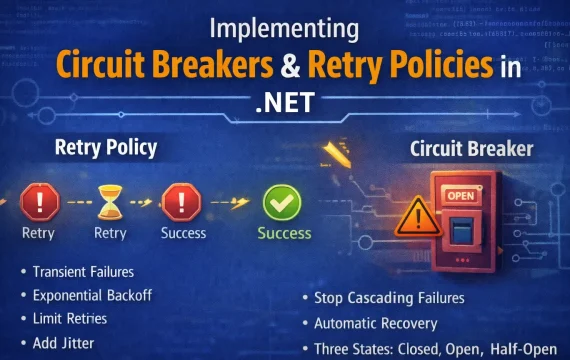
🔁 Resiliency: Retries, Timeouts, and Circuit Breakers
Failures are normal in distributed systems:
- Networks fail
- Services restart
- Dependencies throttle
Resiliency must be designed, not patched.
Effective .NET systems:
- Apply retries with exponential backoff
- Use timeouts consistently
- Protect dependencies with circuit breakers
- Avoid retry storms
These behaviors should be standardized—preferably through shared libraries or platform conventions—rather than implemented ad-hoc per service.
📊 Observability: Logging, Metrics, and Tracing
In monoliths, debugging often meant checking logs. In distributed systems, logs alone are not enough.
Effective observability requires:
- Structured logging
- Correlation IDs
- Distributed tracing
- Consistent metrics
Every request should be traceable across service boundaries. Without this, diagnosing production issues becomes guesswork.
Observability is not a feature—it’s an operational requirement.
⚙ Configuration & Secrets Management
Configuration becomes harder as systems scale:
- Environment differences
- Secret rotation
- Service-specific settings
Anti-patterns include:
- Hard-coded values
- Secrets in source control
- Environment-specific code paths
Well-designed .NET systems:
- Externalize configuration
- Centralize secrets
- Treat configuration as data, not code
- Support dynamic updates where possible
This keeps deployments predictable and secure.
🧠 Principle 2: Prefer Platform Capabilities Over Custom Code
One of the biggest mistakes teams make is re-implementing cross-cutting concerns repeatedly.
In distributed .NET systems, many concerns are better handled by:
- The hosting platform
- Shared infrastructure
- Standardized middleware
- Proven libraries
Custom implementations increase risk, maintenance cost, and inconsistency—especially as teams and services grow.
⚖ Centralization vs Autonomy: Finding the Balance
Not everything should be centralized blindly.
Good rules of thumb:
- Centralize policies and standards
- Decentralize business decisions
- Standardize behavior, not implementation details
Cross-cutting concerns should enable teams—not constrain them.
🏁 Final Thoughts
Handling cross-cutting concerns well is one of the strongest indicators of a mature distributed .NET system.
When done right:
- Business logic stays clean
- Services behave consistently
- Failures are visible and manageable
- Security is predictable
- Teams move faster with less risk
When done poorly:
- Every service becomes a snowflake
- Debugging turns into archaeology
- Reliability erodes over time
In distributed systems, architecture isn’t defined by business logic—it’s defined by how cross-cutting concerns are handled.
Treat them as first-class architectural decisions, not implementation details, and your .NET systems will scale not just technically—but operationally and organizationally as well.