Prilixor

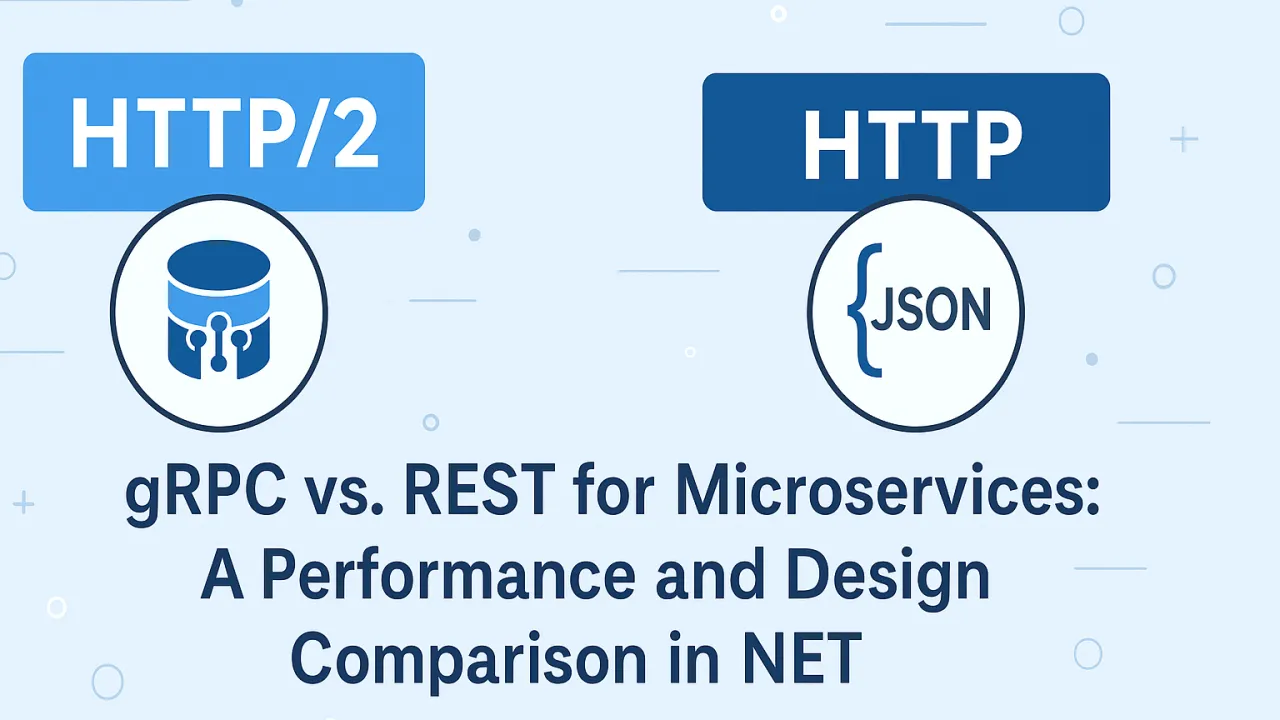
gRPC vs. REST for Microservices: A Performance and Design Comparison in .NET

When designing microservice-to-microservice communication in a .NET ecosystem, the choice between gRPC and REST is one of the most impactful architecture decisions you’ll make. Both approaches are widely used, but they differ sharply in performance characteristics, API design style, tooling, interoperability, and operational trade-offs. This guide breaks those differences down and helps you pick the right tool for each scenario.

A quick primer — what each technology is

  • REST (Representational State Transfer): An architectural style that typically uses HTTP/1.1, human-readable payloads (JSON), and resource-oriented URIs. It’s text-based and highly interoperable with web clients, browsers, and HTTP tooling.
  • gRPC: A high-performance Remote Procedure Call framework that runs over HTTP/2 and uses Protocol Buffers (binary serialization). It supports unary calls, client/server streaming, and bi-directional streaming and is engineered for low latency and compact payloads.

Performance: throughput, latency, and payload size

  • Latency: gRPC generally delivers lower latency than REST because of HTTP/2 multiplexing, header compression, and compact binary payloads. For high-frequency, low-latency RPCs between services, gRPC is often noticeably faster.
  • Throughput: gRPC typically achieves higher throughput due to smaller message sizes and fewer CPU cycles spent serializing/deserializing text JSON payloads.
  • Bandwidth and payload size: Protocol Buffers are much more compact than JSON, which reduces network usage — important in constrained networks or when sending lots of small messages.
  • Real-world caveat: Absolute numbers depend on message sizes, server/client hardware, network conditions, and specific implementations. Always measure using representative workloads. Profiling and benchmarking in your environment should drive final decisions.

API design style and developer experience

  • REST (resource-oriented):
  • gRPC (RPC-oriented):

Interoperability and client support

  • REST:
  • gRPC:

Streaming and real-time communication

  • REST can emulate streaming using long-polling, Server-Sent Events (SSE), or WebSockets, but these are additional technologies with their own trade-offs.
  • gRPC provides first-class support for client streaming, server streaming, and bidirectional streaming out of the box — ideal for real-time telemetry, streaming logs, chat, pipelines, and backpressure-aware flows.

Contract safety and schema evolution

  • gRPC / Protocol Buffers:
  • REST / JSON:

Tooling, observability and debugging

  • REST:
  • gRPC:

Security and transport considerations

  • REST:
  • gRPC:
  • Note: For internal microservices, you may also layer service mesh mutual TLS (e.g., Istio, Linkerd) regardless of REST or gRPC choice.

Deployment and operational concerns

  • Proxy and load balancer behavior:
  • Caching:
  • Compatibility with existing infra:

Scalability and resource usage

  • gRPC typically uses less CPU and network per RPC due to binary serialization and HTTP/2 efficiencies, which can reduce cost at scale.
  • REST benefits from statelessness and CDN caching for read-heavy workloads, which can also scale well and offload backend services.

When to choose gRPC (ideal use cases)

  • High-performance internal microservice communication where low latency and high throughput matter.
  • Streaming scenarios: telemetry, event ingestion, live feeds, and bi-directional pipelines.
  • Strongly-typed service contracts and strict schema evolution are required.
  • Polyglot microservices where teams can standardize on gRPC libraries.
  • Controlled environments where you manage client libraries and runtime stacks (server-to-server).

When to choose REST (ideal use cases)

  • Public-facing APIs, partner integrations, or browser-first clients.
  • When human-readability, easy debugging, and simple curl/browser testing matter.
  • When caching with CDNs and HTTP semantics is a major performance lever.
  • If your infrastructure or proxies lack mature HTTP/2 support and upgrading is not an option.
  • For teams that prefer resource-oriented design and loose coupling with many external consumers.

Hybrid patterns: best of both worlds

  • Expose gRPC internally, REST externally: Keep high-performance gRPC between services, and expose REST/JSON endpoints to external clients or partners via an API gateway or an adapter layer.
  • gRPC + gRPC-Web: If you want the performance of gRPC but also need browser compatibility, use gRPC-Web (via proxy) to allow browsers to call gRPC services.
  • Wrap or translate: Use a facade service that translates between REST and gRPC as a migration strategy or when supporting diverse clients.

Migration & practical advice for .NET teams

  • Measure first: Profile real workloads and latency patterns. Don’t assume gRPC is always faster for your specific payloads.
  • Start small: Pilot gRPC for a latency-sensitive service or adopt it in new services rather than doing a big-bang migration.
  • Design contracts carefully: Use Protobuf’s best practices when using gRPC and enforce schema governance.
  • Plan observability: Ensure logging, tracing, and metrics cover gRPC metadata, request sizes, and streaming lifecycles.
  • Check infra compatibility: Validate load balancers, API gateways, and service meshes support HTTP/2 and streaming before committing.
  • Consider developer experience: gRPC offers compile-time safety and generated clients that speed development; provide onboarding docs and tooling for teams.

Decision checklist (short)

  • Do you require low latency and high throughput between services? → lean gRPC.
  • Do you need browser-native support and broad third-party interoperability? → choose REST.
  • Is streaming or bi-directional communication important? → gRPC is likely better.
  • Will caching via CDNs be a primary optimization? → REST typically fits better.
  • Can you control and upgrade infrastructure to support HTTP/2? → gRPC becomes viable.
  • Do you want strongly-typed contracts and code generation? → gRPC + Protobuf is attractive.

Conclusion

There’s no universal winner. gRPC shines for internal, performance-sensitive, and streaming scenarios; REST remains the best choice for public, browser-compatible, and highly discoverable APIs. Many successful .NET microservice architectures use both: gRPC for efficient internal service-to-service calls and REST for external-facing endpoints. Make the choice based on measurable performance goals, client compatibility needs, operational readiness, and developer ergonomics — and validate with benchmarks in your environment.

API Versioning Strategies in ASP.NET Core: Choosing the Right Approach

API versioning is essential for any public or long-lived API. It lets you evolve features and fix problems without breaking existing clients. This guide compares four common versioning methods — URL path, query string, header, and media type — and helps you choose the right strategy for your API’s lifecycle.

URL Path Versioning (e.g., /v1/…)

What it is: The version is embedded in the path of the endpoint.

Pros

  • Extremely visible and discoverable for clients.
  • Works cleanly with caching, CDNs, and proxies.
  • Simple to test and debug; routing is straightforward.

Cons

  • Can lead to duplicated endpoints across versions and extra maintenance.
  • Ties resource identifiers to version numbers, which some consider less pure REST design.
  • Clients must change URLs to move to a new version.

Best for: Public APIs, heavy use of CDNs, or scenarios where explicit client control and discoverability matter.

Query String Versioning (e.g., ?v=1)

What it is: The version is supplied as a query parameter on the endpoint.

Pros

  • Keeps the base resource path stable.
  • Easy to opt-in to a different version without changing URL structure.
  • Good for feature toggles and testing alternate behaviors.

Cons

  • Slightly less visible than path-based versioning.
  • Some caching layers treat query strings differently, which can complicate caching.
  • Less REST-pure since resource identity is decoupled from representation.

Best for: Internal APIs, gradual rollouts, or situations where maintaining stable base URIs is desirable.

Header-Based Versioning (e.g., Api-Version header)

What it is: The client specifies the API version in a request header.

Pros

  • Keeps URLs clean and resource-focused.
  • Separates transport/routing concerns from version negotiation.
  • Useful when versioning is primarily an operational matter.

Cons

  • Less discoverable to humans and intermediate systems.
  • Some clients and tools make custom headers harder to set or inspect.
  • Requires more server-side negotiation and careful documentation.

Best for: B2B or internal APIs where clients can reliably set headers and you want stable URIs.

Media Type Versioning (Content Negotiation)

What it is: The version is encoded in the media type used for content negotiation.

Pros

  • Fully leverages HTTP content negotiation semantics.
  • Separates resource identity from representation changes.
  • Allows fine-grained control over representations.

Cons

  • Complex to implement and document correctly.
  • Some intermediaries and client tooling may not handle custom media types well.
  • Harder for humans to discover without clear documentation.

Best for: Mature public APIs where representation-level evolution is a strategic need and clients are sophisticated.

How Versioning Choices Affect Clients and Operations

  • Discoverability: Path-based versions are easiest for humans to spot; headers and media types are more opaque.
  • Caching and CDNs: URL path and query string are generally cache-friendly; header and media-type strategies require explicit cache configuration.
  • Client Simplicity: Path and query string are simplest for a broad range of client types; header and media-type approaches need clients able to set headers and negotiate content.
  • Backward Compatibility: Any approach can be designed for compatibility; the real difference is how effortless it is for clients to migrate to newer versions.
  • Operational Complexity: Header and media-type strategies add routing and negotiation complexity on the server; path and query are straightforward to implement and log.

Practical Recommendations

  1. Public API with many external consumers Prefer path-based versioning for clarity, discoverability, and cache friendliness. Publish migration guides and deprecation timelines.
  2. Internal API with trusted clients Query string or header-based versioning adds flexibility while keeping base URIs stable.
  3. APIs focused on representation changes Use media type versioning when the representation itself evolves and content negotiation is central.
  4. Hybrid strategies Consider combining approaches: use path-based versioning for major breaking changes, and headers for experimental or minor feature flags.
  5. Tooling and client constraints If clients are often simple (browsers, lightweight SDKs), favor path or query-based approaches. If you rely on CDNs, prefer path/query for predictable caching.

Versioning Best Practices (applies regardless of approach)

  • Document everything clearly. Provide change logs, migration instructions, and examples for each version.
  • Treat major versions as breaking changes. Use minor versions for backward-compatible additions and enhancements.
  • Support co-existence. Keep older versions available during migration windows and communicate deprecation schedules well in advance.
  • Automate compatibility tests. Use contract testing or integration tests to detect breaking changes before release.
  • Provide client helpers. Offer SDKs, sample clients, or migration scripts to simplify adoption for consumers.
  • Default behavior. When no version is supplied, return a documented default and consider including a header that indicates the current stable version.
  • Deprecation policy. Publish predictable timelines for retirement of versions and stick to them.

Final Thoughts

There’s no one-size-fits-all answer to API versioning. The best choice depends on your audience, tooling, caching needs, and how you expect the API to evolve. Path-based versioning is often best for wide public consumption, while header/query methods can offer flexibility for internal or controlled ecosystems. Media type versioning is ideal when representation negotiation is a strategic priority.

Make versioning part of your API design from day one. Good versioning practices protect your users from breaking changes, enable safe evolution, and reduce long-term maintenance costs.

RESTful API Design Principles: Crafting Intuitive and Scalable Endpoints

In today’s digital landscape, APIs are the connective tissue of modern applications. They link systems, enable integrations, and empower innovation across platforms. Among various architectures, REST (Representational State Transfer) stands out for its simplicity, scalability, and wide adoption — especially within .NET applications.

Designing a RESTful API, however, is more than just exposing endpoints. It’s about adhering to principles that make your APIs intuitive for developers, stable in production, and scalable for the future. Let’s explore how to achieve that.

1. Statelessness — Keeping It Clean and Scalable

The foundation of REST is stateless communication. Every request should carry all the information the server needs to process it, without relying on stored session data.

This principle makes scaling easy — any server instance can process any request. It also ensures better fault tolerance, simpler debugging, and improved performance in distributed systems.

Think of statelessness as treating every request as new — no memory of the past, no dependency on the future. This purity in design enhances reliability and scalability at every level.

2. Resource-Based Design — Thinking in Terms of “Things,” Not “Actions”

At its core, REST revolves around resources — entities that represent real-world concepts such as users, products, or orders. Each resource is uniquely identified by a URI and manipulated through standard HTTP methods.

Instead of designing APIs around actions (like “get” or “create”), REST encourages designing around objects and relationships. This makes your API self-explanatory — developers can understand how to interact with it just by reading the endpoint names.

A resource-based structure also makes your API future-proof. As systems evolve, new resources can be added naturally without breaking existing functionality.

3. Uniform Interface — Consistency is the Key to Simplicity

A hallmark of good RESTful design is a uniform interface. This means consistent conventions for how resources are accessed and represented across your entire API.

Key aspects include:

  • Standardized Methods: Using well-known operations (GET, POST, PUT, DELETE) to define intent.
  • Consistent Responses: Maintaining uniform response structures across endpoints.
  • Clear Communication: Returning appropriate status codes and messages to inform clients about the success or failure of their requests.

A consistent API feels familiar, predictable, and effortless to consume — even for new developers.

4. Versioning — Building for Growth Without Breaking the Past

Change is inevitable. As your application evolves, your API must adapt while maintaining compatibility with existing clients.

That’s where API versioning becomes essential. By including versions in your endpoint structure or headers, you ensure that changes — whether structural or behavioral — don’t disrupt existing users.

Versioning brings stability, enables safe innovation, and gives teams the confidence to iterate without fear of breaking legacy integrations.

5. Validation and Error Handling — Communicating Clearly

A great API doesn’t just work when everything is right — it also communicates clearly when something goes wrong.

Consistent and meaningful error handling enhances developer experience and reduces confusion. Every response should be informative, human-readable, and actionable. For instance, if an API rejects a request, it should explain why — not just return a failure code.

Clarity here isn’t optional; it’s the difference between an API that developers love and one they avoid.

6. Security and Reliability — The Non-Negotiables

APIs are often the gateway to your most valuable data, which makes security a top priority.

Essential REST security practices include:

  • Using HTTPS for all communication to ensure data encryption.
  • Implementing token-based authentication (like OAuth 2.0 or JWT) to verify user identity.
  • Applying authorization layers to control access based on roles and permissions.
  • Validating and sanitizing inputs to prevent malicious data or injection attacks.

Security must be baked into every layer — not added later. A secure API builds user trust and protects organizational integrity.

7. Documentation and Discoverability — Empowering Developers

Even the most well-architected API is incomplete without clear documentation. Good documentation acts as a map and guide, helping consumers understand endpoints, parameters, response types, and expected behaviors.

Tools like Swagger (OpenAPI) make APIs self-descriptive and interactive, but great documentation goes beyond automation — it tells the story of how to use the API effectively.

A well-documented API reduces onboarding time, minimizes support requests, and increases adoption.

8. Common Pitfalls to Avoid

While building RESTful APIs, many teams fall into common traps that can undermine long-term success:

  • Mixing business logic with transport logic.
  • Using verbs instead of resources in endpoints.
  • Returning inconsistent data formats.
  • Ignoring pagination or filtering in large datasets.
  • Failing to plan for versioning and deprecation.

Avoiding these pitfalls is as important as following best practices — they ensure your API remains elegant, performant, and maintainable.

Conclusion — Designing for Clarity, Consistency, and Growth

RESTful API design is not just a technical decision; it’s a communication design choice between your system and its consumers.

A well-designed API is predictable, consistent, and scalable — enabling developers to integrate with confidence and systems to grow without friction.

By embracing REST’s core principles — statelessness, resource orientation, uniform interfaces, and clear communication — you create APIs that stand the test of time, evolve gracefully, and empower both your developers and users.

REST, when done right, is not just about transferring data — it’s about building trust through thoughtful design.

Building Robust Web APIs with ASP.NET Core: Beyond CRUD Operations

Web APIs are the backbone of modern applications, enabling communication between front-end clients, mobile apps, and third-party services. While basic CRUD operations are important, building robust, secure, and maintainable APIs requires following advanced best practices. ASP.NET Core provides a powerful framework to implement these practices and ensure APIs are production-ready.

1. Effective API Versioning

APIs evolve over time, and changes can break existing clients. Implementing API versioning allows smooth transitions and backward compatibility. You can manage versions through URLs, headers, or query strings. This ensures that adding new features or modifying existing endpoints doesn’t disrupt current users.

2. Comprehensive Global Error Handling

A strong API provides consistent and meaningful error responses while keeping sensitive details hidden. By implementing global error handling, developers can standardize responses, maintain clarity for clients, and log issues for diagnostics. This practice ensures that unexpected errors are managed gracefully and improves the overall reliability of the API.

3. Robust Authentication and Authorization

Security is critical. ASP.NET Core supports modern authentication and authorization techniques such as JWT and OAuth. Authentication verifies the user’s identity, while authorization ensures that only the right users can access specific resources. Combining these with secure communication channels like HTTPS protects sensitive data and prevents unauthorized access.

4. Advanced Routing Strategies

Effective routing makes APIs easier to maintain and scale. Using clear, resource-oriented routes, nested resources for hierarchical data, and route constraints improves readability and organization. This also allows for more complex API scenarios, such as supporting multiple API versions simultaneously without confusing consumers.

5. Additional Best Practices

  • Use Data Transfer Objects (DTOs) to separate internal models from the API contract.
  • Document your API with tools like Swagger/OpenAPI to provide interactive documentation for clients.
  • Implement rate limiting and throttling to prevent abuse and ensure consistent performance.
  • Use caching strategies to improve response times for frequently requested data.
  • Test your API thoroughly to ensure endpoints work correctly under various conditions.

Final Thoughts

Building robust ASP.NET Core Web APIs goes far beyond CRUD operations. By focusing on versioning, global error handling, security, advanced routing, and additional best practices like documentation and caching, developers can deliver APIs that are scalable, secure, and maintainable.

💡 Pro Tip: Treat your API as a product—plan for evolution, security, and performance from the start, not as an afterthought.