

When designing microservice-to-microservice communication in a .NET ecosystem, the choice between gRPC and REST is one of the most impactful architecture decisions you’ll make. Both approaches are widely used, but they differ sharply in performance characteristics, API design style, tooling, interoperability, and operational trade-offs. This guide breaks those differences down and helps you pick the right tool for each scenario.
A quick primer — what each technology is
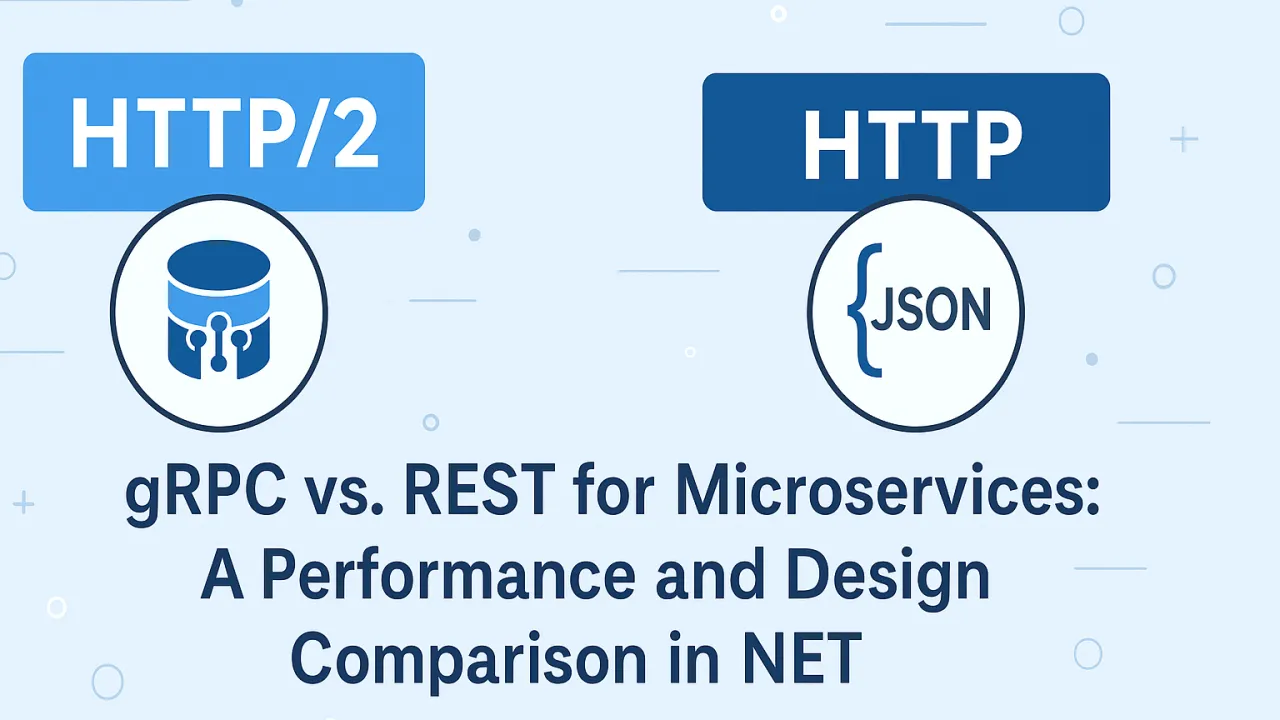
- REST (Representational State Transfer): An architectural style that typically uses HTTP/1.1, human-readable payloads (JSON), and resource-oriented URIs. It’s text-based and highly interoperable with web clients, browsers, and HTTP tooling.
- gRPC: A high-performance Remote Procedure Call framework that runs over HTTP/2 and uses Protocol Buffers (binary serialization). It supports unary calls, client/server streaming, and bi-directional streaming and is engineered for low latency and compact payloads.
Performance: throughput, latency, and payload size
- Latency: gRPC generally delivers lower latency than REST because of HTTP/2 multiplexing, header compression, and compact binary payloads. For high-frequency, low-latency RPCs between services, gRPC is often noticeably faster.
- Throughput: gRPC typically achieves higher throughput due to smaller message sizes and fewer CPU cycles spent serializing/deserializing text JSON payloads.
- Bandwidth and payload size: Protocol Buffers are much more compact than JSON, which reduces network usage — important in constrained networks or when sending lots of small messages.
- Real-world caveat: Absolute numbers depend on message sizes, server/client hardware, network conditions, and specific implementations. Always measure using representative workloads. Profiling and benchmarking in your environment should drive final decisions.
API design style and developer experience
- REST (resource-oriented):
- gRPC (RPC-oriented):
Interoperability and client support
- REST:
- gRPC:
Streaming and real-time communication
- REST can emulate streaming using long-polling, Server-Sent Events (SSE), or WebSockets, but these are additional technologies with their own trade-offs.
- gRPC provides first-class support for client streaming, server streaming, and bidirectional streaming out of the box — ideal for real-time telemetry, streaming logs, chat, pipelines, and backpressure-aware flows.
Contract safety and schema evolution
- gRPC / Protocol Buffers:
- REST / JSON:
Tooling, observability and debugging
- REST:
- gRPC:
Security and transport considerations
- REST:
- gRPC:
- Note: For internal microservices, you may also layer service mesh mutual TLS (e.g., Istio, Linkerd) regardless of REST or gRPC choice.
Deployment and operational concerns
- Proxy and load balancer behavior:
- Caching:
- Compatibility with existing infra:
Scalability and resource usage
- gRPC typically uses less CPU and network per RPC due to binary serialization and HTTP/2 efficiencies, which can reduce cost at scale.
- REST benefits from statelessness and CDN caching for read-heavy workloads, which can also scale well and offload backend services.
When to choose gRPC (ideal use cases)
- High-performance internal microservice communication where low latency and high throughput matter.
- Streaming scenarios: telemetry, event ingestion, live feeds, and bi-directional pipelines.
- Strongly-typed service contracts and strict schema evolution are required.
- Polyglot microservices where teams can standardize on gRPC libraries.
- Controlled environments where you manage client libraries and runtime stacks (server-to-server).
When to choose REST (ideal use cases)
- Public-facing APIs, partner integrations, or browser-first clients.
- When human-readability, easy debugging, and simple curl/browser testing matter.
- When caching with CDNs and HTTP semantics is a major performance lever.
- If your infrastructure or proxies lack mature HTTP/2 support and upgrading is not an option.
- For teams that prefer resource-oriented design and loose coupling with many external consumers.
Hybrid patterns: best of both worlds
- Expose gRPC internally, REST externally: Keep high-performance gRPC between services, and expose REST/JSON endpoints to external clients or partners via an API gateway or an adapter layer.
- gRPC + gRPC-Web: If you want the performance of gRPC but also need browser compatibility, use gRPC-Web (via proxy) to allow browsers to call gRPC services.
- Wrap or translate: Use a facade service that translates between REST and gRPC as a migration strategy or when supporting diverse clients.
Migration & practical advice for .NET teams
- Measure first: Profile real workloads and latency patterns. Don’t assume gRPC is always faster for your specific payloads.
- Start small: Pilot gRPC for a latency-sensitive service or adopt it in new services rather than doing a big-bang migration.
- Design contracts carefully: Use Protobuf’s best practices when using gRPC and enforce schema governance.
- Plan observability: Ensure logging, tracing, and metrics cover gRPC metadata, request sizes, and streaming lifecycles.
- Check infra compatibility: Validate load balancers, API gateways, and service meshes support HTTP/2 and streaming before committing.
- Consider developer experience: gRPC offers compile-time safety and generated clients that speed development; provide onboarding docs and tooling for teams.
Decision checklist (short)
- Do you require low latency and high throughput between services? → lean gRPC.
- Do you need browser-native support and broad third-party interoperability? → choose REST.
- Is streaming or bi-directional communication important? → gRPC is likely better.
- Will caching via CDNs be a primary optimization? → REST typically fits better.
- Can you control and upgrade infrastructure to support HTTP/2? → gRPC becomes viable.
- Do you want strongly-typed contracts and code generation? → gRPC + Protobuf is attractive.
Conclusion
There’s no universal winner. gRPC shines for internal, performance-sensitive, and streaming scenarios; REST remains the best choice for public, browser-compatible, and highly discoverable APIs. Many successful .NET microservice architectures use both: gRPC for efficient internal service-to-service calls and REST for external-facing endpoints. Make the choice based on measurable performance goals, client compatibility needs, operational readiness, and developer ergonomics — and validate with benchmarks in your environment.