
Blogs
What are you working on?
Filter posts by topic
Latest
All posts
Showing 19–24 of 81 posts
Architecture 3 min read
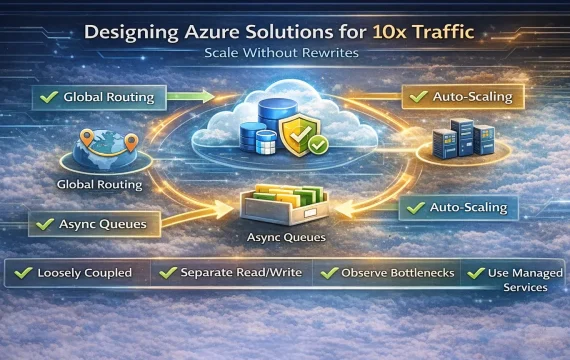
How to Design Azure Solutions for 10x Traffic Without Rewrites
Most systems don’t fail because they can’t handle traffic—they fail because they were never designed to scale gracefully. When traffic grows 10×, teams often assume a rewrite is inevitable. In reality, large traffic increases rarely require new architectures; they require better architectural decisions early on.
Architecture 2 min read
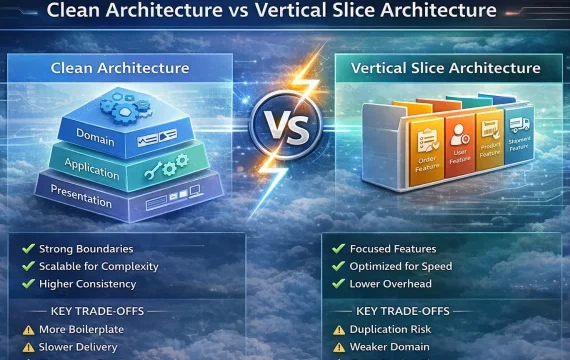
Trade-offs Between Clean Architecture vs Vertical Slice Architecture
Choosing between Clean Architecture and Vertical Slice Architecture is less about right or wrong and more about understanding trade-offs. Both approaches are widely used in modern .NET systems, but they optimize for very different priorities. Teams often run into problems not because they chose the wrong architecture, but because they chose it without aligning it to their context.
Architecture 3 min read
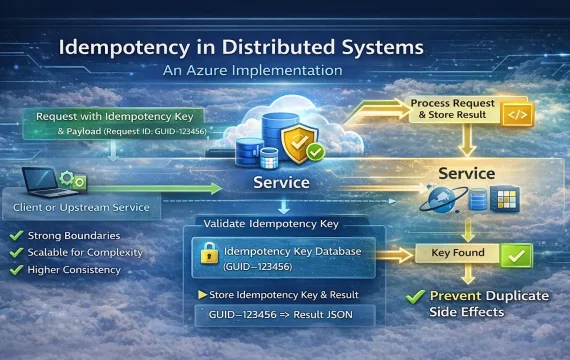
Idempotency in Distributed Systems – A Real Azure Implementation
In distributed systems, duplicate requests are not an edge case—they are inevitable. Network retries, client timeouts, message redelivery, and partial failures all lead to the same operation being executed more than once. Without proper safeguards, these duplicates cause corrupted data, double charges, inconsistent state, and hard-to-debug production incidents.
Architecture 3 min read
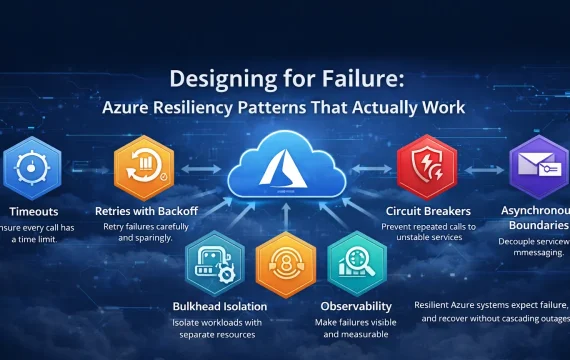
Designing for Failure: Azure Resiliency Patterns That Actually Work
In cloud-native systems, failure is not an exception—it is a certainty. Azure provides highly available infrastructure, but no platform can eliminate network latency, transient faults, throttling, or dependency outages. The real difference between resilient and fragile systems lies in how applications are designed to respond when failures occur. Designing for failure means accepting that components will break and ensuring the system can absorb, isolate, and recover from those failures without cascading impact.
Architecture 4 min read
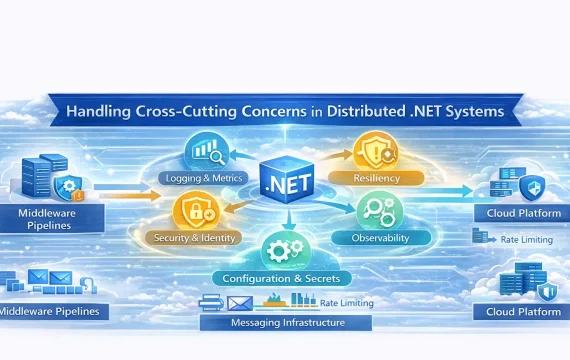
Handling Cross-Cutting Concerns in Distributed .NET Systems
As .NET applications evolve into distributed systems—spanning microservices, APIs, background workers, and serverless components—certain concerns begin to appear everywhere. Logging, security, resiliency, observability, configuration, and error handling cut across every service and every layer.
Architecture 3 min read
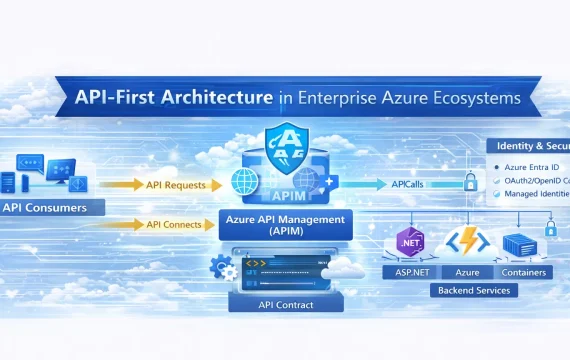
API-First Architecture in Enterprise Azure Ecosystems
In modern enterprise Azure ecosystems, APIs are no longer just technical integration points—they are the primary interface through which systems, teams, and partners interact. As organizations scale, the number of consumers, platforms, and dependencies grows rapidly. Without a clear API strategy, this growth leads to tight coupling, fragile integrations, and slow delivery. API-first architecture addresses this challenge by treating APIs as first-class products rather than implementation by-products.