


In an era of rapid development cycles, evolving business requirements, and scalable cloud-native systems, writing maintainable and adaptable software is no longer optional—it’s essential.
At the heart of this capability lies Object-Oriented Programming (OOP). In the .NET ecosystem, OOP is not just a theoretical concept but a practical design philosophy that shapes robust, enterprise-grade applications.
Let’s revisit the four foundational pillars of OOP—Encapsulation, Inheritance, Polymorphism, and Abstraction—and understand why they remain indispensable for modern C# and .NET development.
1. Encapsulation: Safeguarding Business Logic
Encapsulation is about controlling access to an object’s internal state and behavior. Instead of exposing everything freely, well-designed objects reveal only what is necessary.
Why it matters:
- Protects critical business rules from accidental misuse
- Reduces system-wide impact when internal logic changes
- Improves reliability and predictability of components
In real-world .NET applications, encapsulation ensures that domain logic stays consistent and resilient, even as applications grow in complexity.
Result: Cleaner APIs, safer code, and fewer unintended side effects.
2. Inheritance: Structured Reuse with Purpose
Inheritance allows shared behavior and characteristics to be defined once and reused across related components. When used correctly, it promotes consistency and reduces duplication.
Where it adds value:
- Establishing common behavior across related entities
- Defining base responsibilities in frameworks or shared layers
- Enforcing consistency in system design
However, inheritance should model true relationships, not convenience. Overuse can introduce rigidity.
Result: A well-organized hierarchy that supports reuse without sacrificing clarity.
3. Polymorphism: Designing for Change
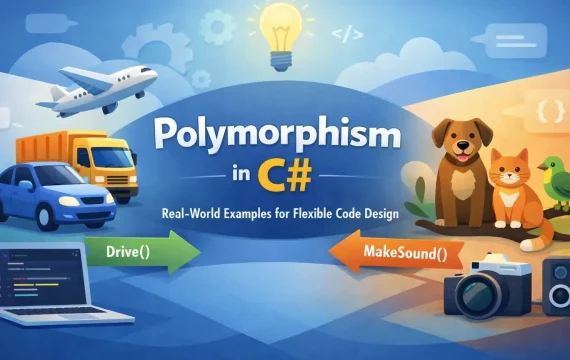
Polymorphism enables different implementations to be treated uniformly through a common interface or contract. This is one of the most powerful tools for building flexible systems.
Why it’s essential in modern .NET:
- Supports dependency injection and loose coupling
- Enables easy swapping of implementations
- Encourages adherence to the Open/Closed Principle
By programming against behavior rather than concrete details, systems become easier to extend and test.
Result: Highly adaptable architectures that evolve without frequent rewrites.
4. Abstraction: Clarity Through Simplicity
Abstraction focuses on what a component does, not how it does it. It removes unnecessary details and highlights intent.
In practice, abstraction helps:
- Reduce cognitive complexity
- Improve collaboration across teams
- Enable parallel development and testing
Well-designed abstractions form the backbone of clean architecture and long-term maintainability.
Result: Systems that are easier to understand, maintain, and scale.
How These Principles Work Together
These pillars are most powerful when applied together:
- Encapsulation protects integrity
- Abstraction defines clear boundaries
- Inheritance enables structured reuse
- Polymorphism provides flexibility
When balanced correctly, they produce software that is resilient to change and aligned with business evolution.
Final Thoughts
Mastering OOP in C# is less about syntax and more about design thinking. In the .NET ecosystem, strong OOP principles translate directly into:
- Maintainable codebases
- Scalable architectures
- Faster onboarding for teams
- Long-term business value
OOP isn’t outdated—it’s foundational. And when applied thoughtfully, it remains one of the most effective tools for building robust, future-ready .NET applications.