
Blogs
What are you working on?
Filter posts by topic
Latest
All posts
Showing 13–18 of 81 posts

DevOps 3 min read
Observability in .NET Using OpenTelemetry (Logs, Traces, Metrics)
In modern distributed systems, performance problems rarely announce themselves clearly. A slow request might be caused by a downstream service, a database bottleneck, thread starvation, memory pressure, or network latency. Without proper visibility, diagnosing such issues becomes guesswork.
Performance 4 min read
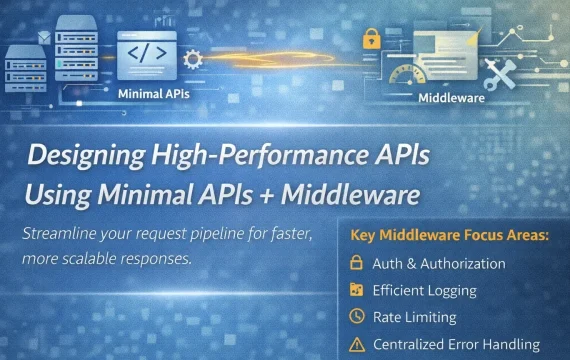
Designing High-Performance APIs Using Minimal APIs + Middleware
High-performance APIs are not built by accident. They are engineered by intentionally reducing overhead, controlling allocations, optimizing the request pipeline, and eliminating unnecessary abstractions. In modern .NET, one of the most effective ways to achieve this is by combining Minimal APIs with a carefully designed middleware pipeline.
Performance 3 min read
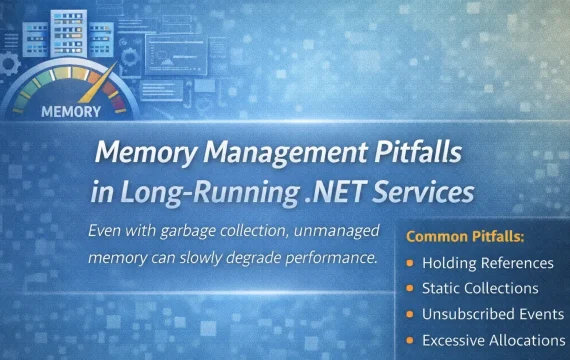
Memory Management Pitfalls in Long-Running .NET Services
Long-running .NET services — background workers, hosted services, APIs, microservices, Windows services — rarely fail on day one. They fail after weeks or months in production. The reason is often not logic errors, but memory behavior.
.NET 2 min read
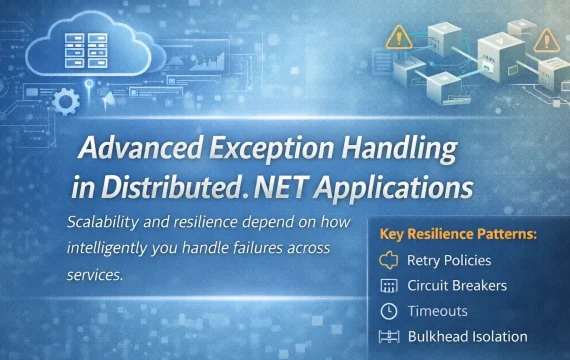
Advanced Exception Handling in Distributed .NET Applications
In distributed .NET systems, exception handling is no longer just about catching errors — it’s about protecting system stability. When applications span APIs, background workers, databases, queues, and third-party services, failures don’t remain isolated. They ripple across services. The real question is not if failure will happen, but how intelligently your system responds when it does.

Performance 3 min read
Threading, Async, and I/O-Bound Workloads in High-Traffic APIs
High-traffic APIs don’t fail because of lack of features. They fail because of poor thread management.When traffic increases, the real bottleneck is rarely business logic. It’s how your application handles threads, asynchronous operations, and I/O-bound workloads.Understanding this difference is what separates scalable APIs from systems that collapse under load.
.NET 2 min read
Modern .NET Is Not Just About .NET 8/9/10 – It’s About Runtime Behavior
When a new .NET version is released, most discussions revolve around upgrades. Teams talk about migrating to .NET 8, preparing for .NET 9, or planning long-term adoption strategies. While staying updated is important, simply upgrading your framework does not automatically modernize your application.