

Choosing between Clean Architecture and Vertical Slice Architecture is less about right or wrong and more about understanding trade-offs. Both approaches are widely used in modern .NET systems, but they optimize for very different priorities. Teams often run into problems not because they chose the wrong architecture, but because they chose it without aligning it to their context.
Clean Architecture – What It Optimizes For
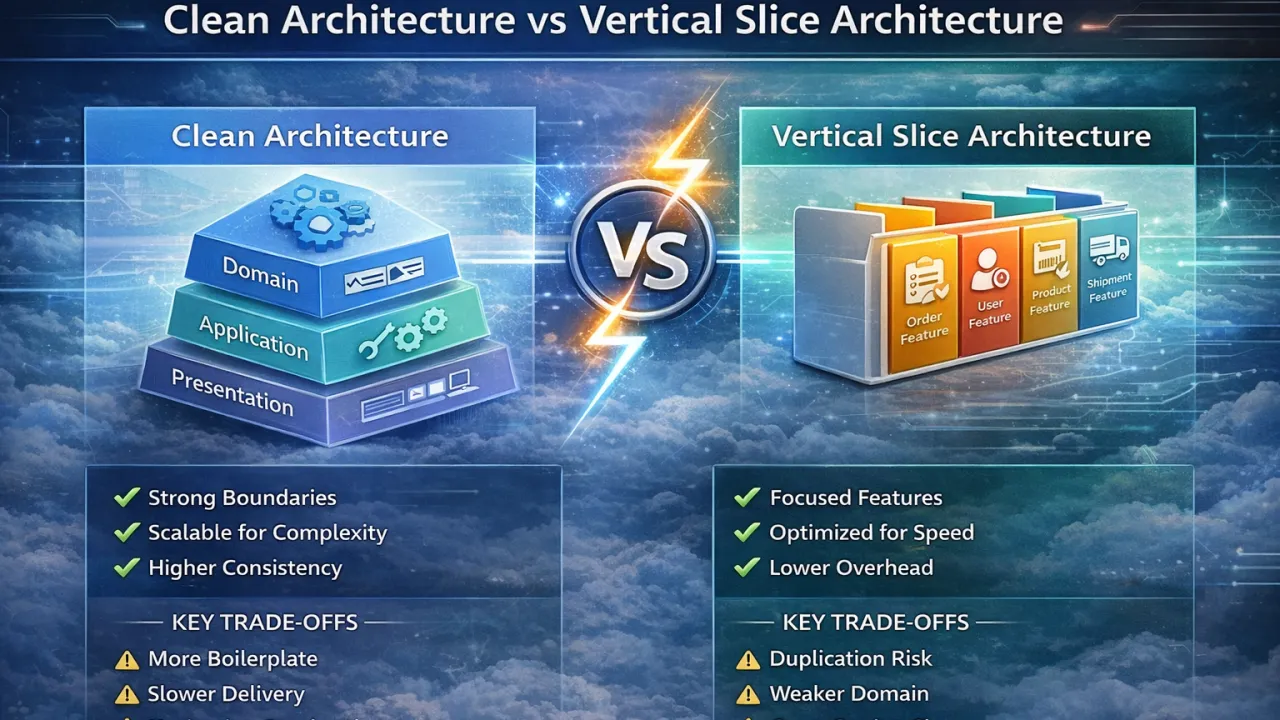
Clean Architecture focuses on strong separation of concerns and long-term maintainability. It emphasizes keeping business rules independent of frameworks and infrastructure.
Key strengths:
- Clear layering and dependency rules
- Strong domain protection and testability
- Easier governance in large teams
- Better suited for complex, stable domains
Trade-offs:
- Higher upfront complexity
- More abstractions and boilerplate
- Slower feature delivery in fast-moving systems
- Increased cognitive overhead for developers
Vertical Slice Architecture – What It Optimizes For
Vertical Slice Architecture organizes code around features and use cases instead of technical layers. Each slice contains everything required to deliver a specific capability.
Key strengths:
- Faster feature development
- Localized changes with minimal side effects
- Lower cognitive load per feature
- Strong alignment with APIs and use cases
Trade-offs:
- Risk of logic duplication
- Weaker domain centralization
- Harder to enforce global consistency
- Requires discipline to manage cross-cutting concerns
In modern cloud-native .NET systems, the debate has shifted. Services are smaller, deployment units are independent, and change frequency is high. This reality often favors vertical slices for application workflows, while clean architectural principles still add value when modeling complex business domains. As a result, many successful teams adopt a hybrid approach—using vertical slices at the edges for delivery speed and clean architecture principles internally where domain integrity matters most.
The real takeaway is this: architecture should follow the rate of change, not ideology. Clean Architecture shines when protecting complex domains over time, while Vertical Slice Architecture excels when rapid iteration and clarity of intent are the priority. Strong teams understand both models and choose deliberately—adapting as the system and organization evolve.