

Blazor has transformed full-stack .NET development by enabling developers to write C# directly in the browser. This eliminates the long-standing division between backend C# development and frontend JavaScript frameworks, bringing a unified development experience.
For many teams, this shift means:
- Shorter development cycles due to shared code and models between client and server.
- Simplified architecture with less need for JavaScript-heavy stacks.
- Tighter integration with existing .NET tools, libraries, and security models.
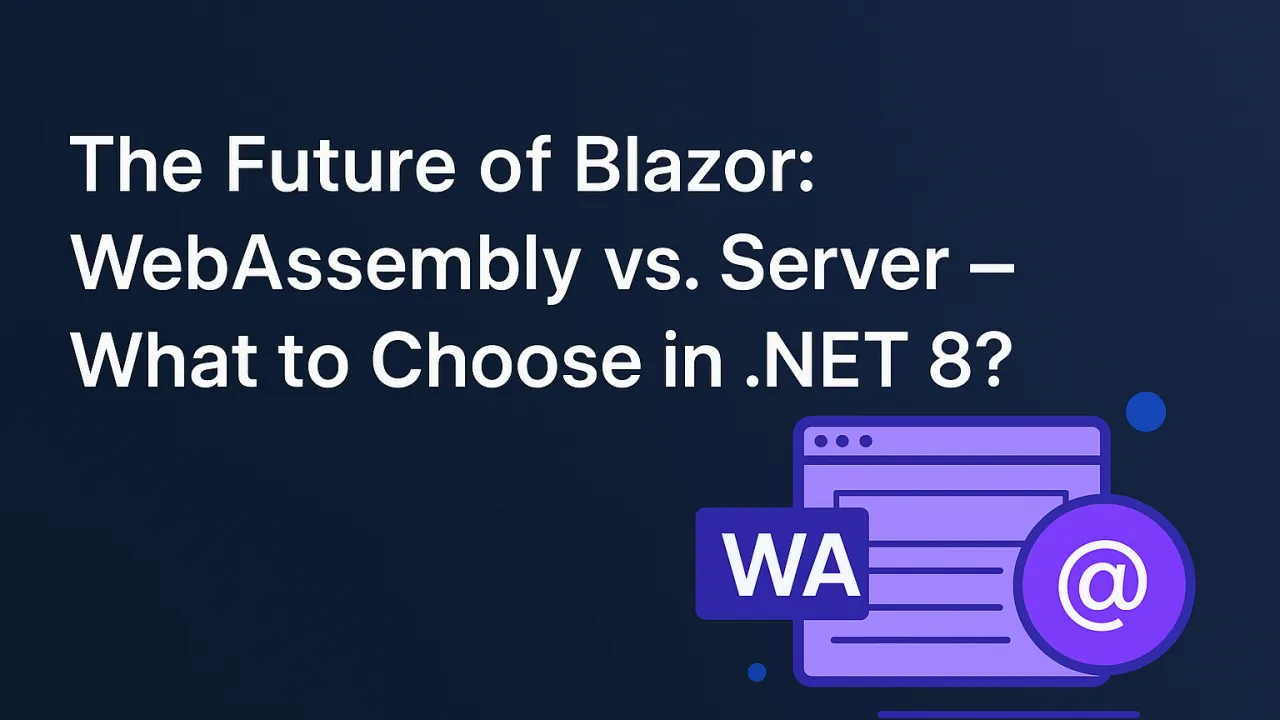
However, one of the biggest architectural decisions when starting with Blazor is choosing between Blazor Server and Blazor WebAssembly. With the release of .NET 8, a third option—Blazor United—changes the decision-making process entirely.
🚀 Blazor Server – Speed and Control
How It Works: With Blazor Server, the UI rendering happens on the server. The browser sends user events (like clicks or form submissions) to the server using a real-time connection (SignalR). The server then updates the UI and sends back the changes.
Advantages:
- Faster initial load times – The browser receives only a small HTML page at first, without downloading the .NET runtime or application code.
- Small client footprint – Ideal for low-powered devices or environments where bandwidth is limited.
- Centralized processing – All business logic and rendering remain on the server, making updates and patches easier.
- Consistent data security – Sensitive operations stay on the server, reducing exposure.
Limitations:
- Requires constant connectivity – Any network disruption can cause the UI to freeze or disconnect.
- Server load – All processing happens server-side, which can increase hosting costs if the user base grows.
Best For:
- Intranet and enterprise apps where latency is predictable.
- Administrative dashboards and control panels.
- Applications with sensitive data that must never leave the server.
🚀 Blazor WebAssembly – Independence in the Browser
How It Works: Blazor WebAssembly (WASM) runs entirely in the user’s browser. The application and .NET runtime are downloaded once and execute client-side without needing continuous server interaction.
Advantages:
- Client-side execution – The app can run even without internet access after the initial load.
- Offline support – Ideal for Progressive Web Apps (PWAs).
- Scalable hosting – Since it’s just static files, you can deploy to a CDN for massive scalability.
- Reduced server load – Most computation is handled in the browser.
Limitations:
- Larger initial load – The runtime and app must be downloaded before the app runs.
- Slower first use on poor networks – Though repeat visits benefit from caching.
- Browser limitations – Performance is bounded by what the browser and client device can handle.
Best For:
- Public-facing SPAs and PWAs.
- Applications that must work offline.
- Scenarios where client-side autonomy is critical.
🏁 What’s New in .NET 8 – Blazor United
.NET 8 introduces Blazor United, a hybrid model that combines the strengths of both Server and WebAssembly approaches. Developers can now use different rendering modes within the same application:
- Server rendering for fast initial load – The first interaction is quick, even on slow networks.
- Seamless switch to WebAssembly – After loading, parts of the application can move client-side for offline capabilities and responsiveness.
- Mixed rendering modes – Different components can use different strategies based on needs.
Why It’s a Game-Changer: Previously, choosing between Server and WebAssembly meant committing to one approach for the entire application. With Blazor United, you can optimize each section individually—leveraging server rendering where speed matters and client-side execution where autonomy or offline support is needed.
📌 Key Decision Factors
When choosing your rendering strategy, consider:
- Hosting environment – Do you have powerful servers and reliable networks? Or do you prefer CDN-based distribution?
- User location and latency – Global audiences may benefit more from client-side execution.
- Offline requirements – If offline functionality is critical, WebAssembly (or hybrid) is essential.
- Security and compliance – Highly sensitive operations might need to stay server-side.
- Scalability – Server rendering consumes more hosting resources, while WebAssembly shifts load to the client.