

For years, relational databases (SQL) have been the default choice for application development. They offer structure, consistency, and powerful querying with SQL. But as applications evolve—handling massive data volumes, complex relationships, and dynamic schemas—developers are increasingly exploring NoSQL databases as a powerful alternative.
In the .NET ecosystem, where scalability, flexibility, and real-time data processing are becoming critical, understanding when to use NoSQL can give your architecture a serious edge.
What is NoSQL?
NoSQL databases are non-relational systems designed to store and manage unstructured or semi-structured data. Unlike SQL databases, they don’t rely on fixed schemas, making them ideal for modern, agile, and distributed applications.
Common types of NoSQL databases include:
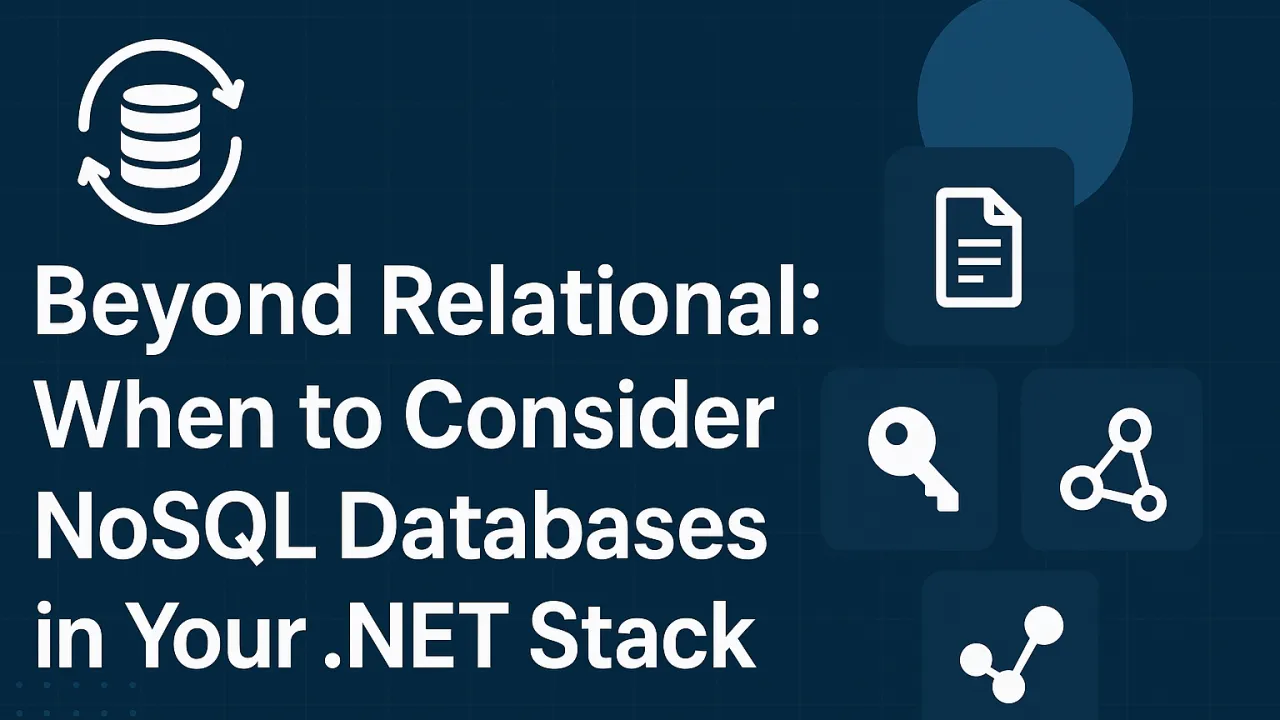
- Document-based (e.g., MongoDB, Azure Cosmos DB)
- Key-value (e.g., Redis, DynamoDB)
- Column-family (e.g., Cassandra, HBase)
- Graph-based (e.g., Neo4j, Cosmos DB Gremlin API)
Each model is designed for a specific data access pattern and scalability goal.
1. Document Databases: Flexibility at Scale
Best for: Dynamic data models, content management, product catalogs, or user profiles.
Examples: MongoDB, Azure Cosmos DB (Core API)
Why use it:
- Store JSON or BSON documents with flexible schemas.
- Great for evolving applications where fields change over time.
- Integrates naturally with .NET applications through native drivers (e.g., MongoDB.Driver).
.NET Use Case: An e-commerce platform storing user carts, product data, and reviews that vary per user can benefit from a document model for flexibility and fast retrieval.
2. Key-Value Stores: Blazing-Fast Access
Best for: Caching, session storage, and quick lookups.
Examples: Redis, Azure Table Storage, Riak
Why use it:
- Stores simple key-value pairs, ensuring lightning-fast access.
- Perfect for distributed caching or real-time data storage.
- Easily integrates into .NET through libraries like StackExchange.Redis.
.NET Use Case: A high-traffic ASP.NET application caching frequently accessed data (like user sessions or configuration settings) can drastically reduce SQL load using Redis.
3. Column-Family Databases: Big Data Powerhouse
Best for: Analytics, large-scale data ingestion, and time-series data.
Examples: Apache Cassandra, HBase
Why use it:
- Organizes data into column families for efficient reads/writes on specific columns.
- Scales horizontally across multiple nodes—ideal for high-volume workloads.
- Offers high availability and fault tolerance.
.NET Use Case: A financial analytics system processing millions of transactions daily can use Cassandra to handle high write throughput with near real-time reads.
4. Graph Databases: Modeling Relationships
Best for: Social networks, recommendation engines, fraud detection.
Examples: Neo4j, Azure Cosmos DB (Gremlin API)
Why use it:
- Stores entities (nodes) and their relationships (edges).
- Enables deep relationship queries (e.g., “friends of friends” or “related products”) efficiently.
- Works well with .NET graph libraries and APIs.
.NET Use Case: A recommendation engine suggesting related products or connections can leverage Neo4j or Cosmos DB’s graph model for fast relationship traversal.
Blending the Best of Both Worlds
Many modern .NET architectures use polyglot persistence—combining both SQL and NoSQL databases. For example:
- Use SQL Server for structured transactional data.
- Use MongoDB or Cosmos DB for flexible, evolving datasets.
- Use Redis for caching and quick session management.
This hybrid approach balances data consistency, flexibility, and performance across different workloads.
🔍 Conclusion
NoSQL databases aren’t replacing relational systems—they’re complementing them. The key lies in understanding your data patterns, performance needs, and scalability goals.
For .NET developers, integrating NoSQL databases like MongoDB, Cassandra, or Cosmos DB opens new possibilities for building scalable, agile, and data-driven applications that thrive in the modern cloud era.