

Choosing how to run your .NET application in Azure is not just a deployment choice — it’s an architectural decision. It affects scalability, cost, operational complexity, and how your team builds and maintains systems.
Many teams either over-engineer with Kubernetes too early or limit themselves with simpler platforms for too long. The real challenge is knowing when to use what.
Understanding the Three Options
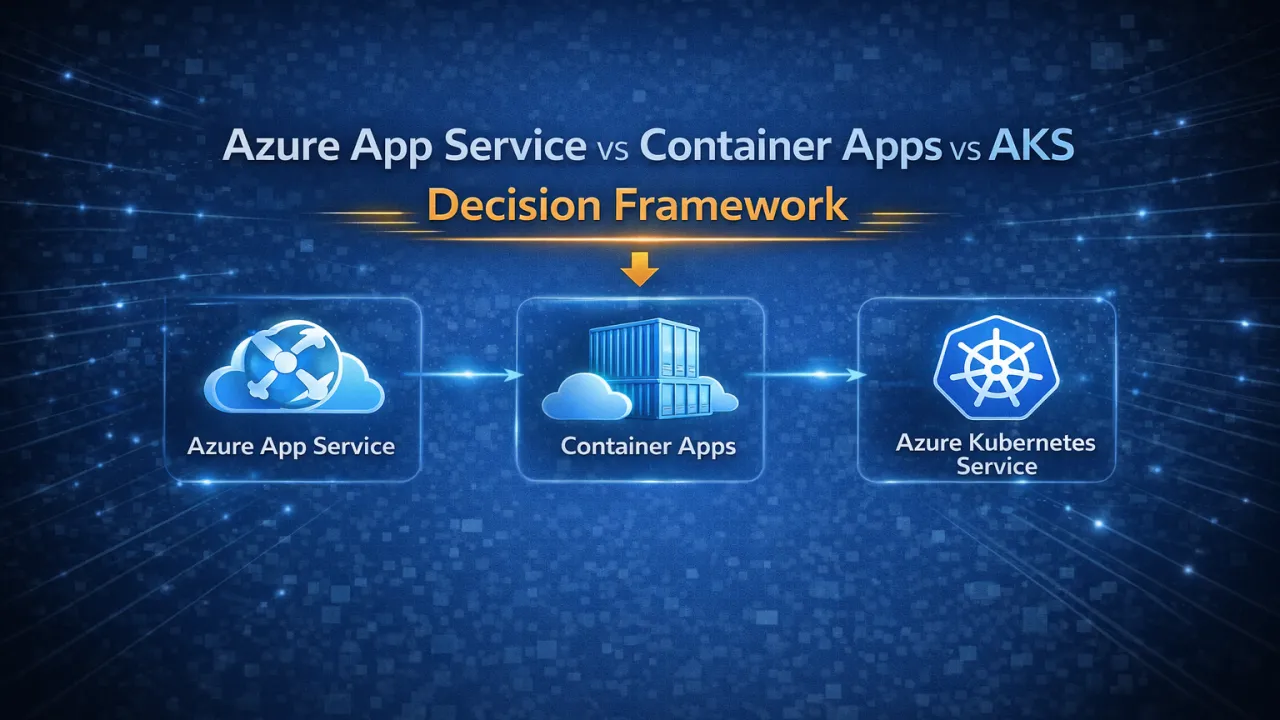
Azure provides three primary compute models:
- Azure App Service → Fully managed platform (PaaS) • Azure Container Apps → Serverless container platform • Azure Kubernetes Service (AKS) → Full container orchestration
Each exists for a reason — and each solves a different level of complexity.
Azure App Service – Best for Simplicity
App Service is the fastest way to deploy and run applications without worrying about infrastructure.
Use it when:
- You’re building standard web apps or APIs • Your architecture is simple or moderately complex • You want minimal DevOps overhead • Speed of development is a priority
Key benefits:
- Fully managed environment • Easy deployment and scaling • Built-in integrations (CI/CD, auth, monitoring)
Limitations:
- Limited flexibility • Not ideal for complex microservices • Less control over runtime environment
Azure Container Apps – The Modern Middle Layer
Container Apps provide a balance between simplicity and flexibility. You get containerization benefits without managing Kubernetes.
Use it when:
- You’re building microservices • Traffic is unpredictable or bursty • You want serverless scaling (including scale to zero) • You want container flexibility without Kubernetes complexity
Key benefits:
- Automatic scaling based on demand • Event-driven architecture support • Built-in Dapr integration • Lower operational overhead than AKS
Limitations:
- Less control than Kubernetes • Some advanced features are limited
Azure Kubernetes Service (AKS) – Maximum Control
AKS is designed for complex, large-scale systems where full control is required.
Use it when:
- You have large microservices architectures • You need advanced deployment strategies • You require custom networking or security setups • Your team has strong DevOps/Kubernetes expertise
Key benefits:
- Full control over orchestration • Advanced scaling and deployment capabilities • Supports complex, enterprise-grade workloads
Limitations:
- High operational complexity • Requires Kubernetes expertise • Higher cost of management
Decision Framework
Instead of asking “Which is best?”, ask:
- How complex is your application architecture? • Do you need full control or managed simplicity? • What is your team’s DevOps maturity? • How critical is cost optimization vs flexibility? • Do you need advanced scaling or just reliable hosting?
Practical Rule of Thumb
- Start with App Service → For simple and fast deployments • Move to Container Apps → For microservices and scalability • Choose AKS → Only when you truly need full orchestration
Over-engineering increases complexity. Under-engineering limits growth.
The Real Insight
There is no “best” service — only the right fit for your use case.
Good architecture is about making trade-offs:
- Simplicity vs control
- Speed vs flexibility
- Cost vs scalability
The smartest teams choose platforms based on actual needs, not trends.