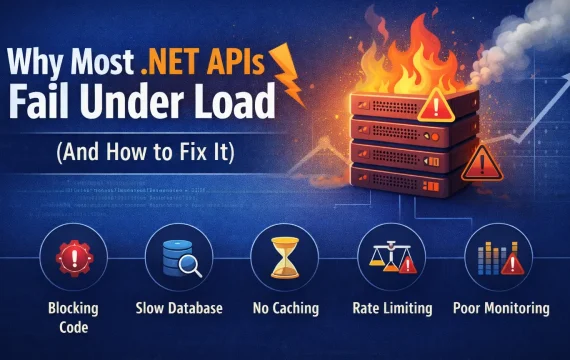



High-performance APIs are not built by accident. They are engineered by intentionally reducing overhead, controlling allocations, optimizing the request pipeline, and eliminating unnecessary abstractions. In modern .NET, one of the most effective ways to achieve this is by combining Minimal APIs with a carefully designed middleware pipeline.
Performance problems in APIs rarely come from business logic alone. They often originate in the framework layers, request handling flow, serialization, blocking calls, and inefficient cross-cutting implementations. The more layers a request passes through, the more overhead accumulates. When traffic scales, those small inefficiencies multiply dramatically.
Minimal APIs were introduced to reduce that structural overhead.
Why Minimal APIs Improve Performance
Traditional controller-based architectures provide structure and flexibility, but they also introduce additional abstractions such as model binding layers, controller instantiation, filters, and attribute routing logic. While these are useful in large enterprise applications, high-throughput APIs benefit from a slimmer execution path.
Minimal APIs simplify endpoint definition by:
- Reducing reflection-heavy patterns • Minimizing middleware branching complexity • Cutting down unnecessary object instantiations • Improving startup performance • Shortening request-to-response execution flow
By defining endpoints directly in the application pipeline, developers gain tighter control over how requests are handled. Fewer abstractions mean fewer allocations and faster execution — especially under high concurrency.
However, Minimal APIs are not a silver bullet. The real performance advantage emerges when combined with well-architected middleware.
Middleware: The Performance Gatekeeper
Middleware forms the backbone of the HTTP request pipeline. Every request flows through it. That means middleware design directly impacts:
- Latency • Throughput • Memory allocation • Thread utilization • CPU consumption
Poorly written middleware can become the primary bottleneck in high-traffic APIs.
In high-performance systems, middleware should be lightweight and focused strictly on cross-cutting concerns, such as:
- Authentication and authorization • Global exception handling • Request logging (optimized and structured) • Rate limiting • Response compression • Caching • Correlation IDs and tracing
Middleware should never execute heavy business logic or long-running operations. Blocking I/O inside middleware defeats the purpose of a high-performance pipeline.
Eliminating Hidden Bottlenecks
To truly design high-performance APIs, attention must go beyond endpoint definitions.
Key considerations include:
1️⃣ Asynchronous Everything
All I/O-bound operations (database calls, HTTP calls, file access) must be asynchronous. Blocking threads reduces scalability and increases thread pool pressure.
2️⃣ Minimize Allocations
High allocation rates increase garbage collection frequency. Use efficient serialization strategies, reuse objects when possible, and avoid unnecessary temporary allocations in hot paths.
3️⃣ Optimize Serialization
JSON serialization can become a performance bottleneck in large APIs. Controlling payload size, avoiding excessive nesting, and using efficient serialization settings can significantly improve response times.
4️⃣ Control Middleware Order
Middleware execution order matters. Placing expensive middleware early in the pipeline affects every request, even those that may not require it.
5️⃣ Measure Under Load
Performance should never be assumed. Benchmarking, stress testing, and observing metrics like allocation rate, request latency (P95/P99), and CPU utilization provide real insight into scalability.
Designing for Throughput and Scalability
When Minimal APIs and middleware are combined strategically, the result is a streamlined request pipeline optimized for:
- Lower latency • Higher requests per second (RPS) • Reduced memory footprint • Faster startup time • Better cloud scalability
In containerized and cloud-native environments, these improvements directly translate into cost efficiency and better horizontal scaling behavior.
High-performance API design is not about removing structure — it is about removing unnecessary complexity. It is about understanding how each request flows through the system and eliminating friction at every stage.
The Real Mindset Shift
Modern API performance is pipeline-driven. It is no longer enough to optimize business logic while ignoring infrastructure layers. The request pipeline itself must be engineered for speed.
Minimal APIs provide control. Middleware provides structure. Together, they enable precision in performance design.
In high-traffic systems, every millisecond matters. Every allocation matters. Every blocking call matters.
Performance is not something you add later. It is something you design from the first line of code.