

In distributed .NET systems, exception handling is no longer just about catching errors — it’s about protecting system stability. When applications span APIs, background workers, databases, queues, and third-party services, failures don’t remain isolated. They ripple across services. The real question is not if failure will happen, but how intelligently your system responds when it does.
Traditional try-catch patterns are insufficient in distributed environments. Logging an error and returning HTTP 500 may work in simple systems, but at scale, this approach creates cascading failures, thread exhaustion, and degraded user experience. Advanced exception handling requires structured decision-making.
In production-grade .NET applications, you must clearly differentiate between:
- Validation errors (client-side issues)
- Business rule violations
- Transient infrastructure failures (timeouts, network glitches)
- Critical system faults
Each category demands a different strategy. Treating all exceptions equally leads to over-retries, unnecessary crashes, or hidden instability.
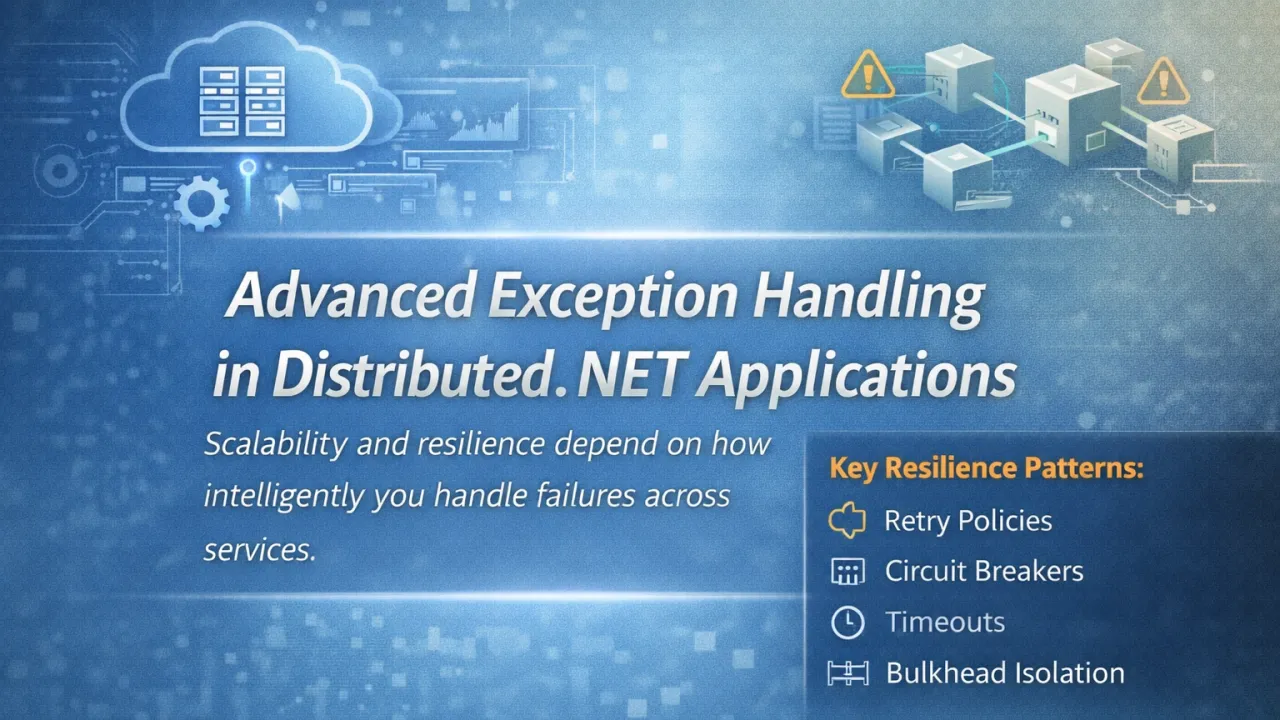
Resilience patterns become essential in distributed architecture. Instead of reacting to failures, systems should contain them using:
- Retry policies with exponential backoff
- Circuit breakers to prevent cascading failures
- Timeouts to protect threads
- Bulkhead isolation to limit failure impact
- Fallback mechanisms for graceful degradation
These patterns transform exception handling from defensive coding into reliability engineering.
Observability also plays a central role. In multi-service environments, debugging without context is nearly impossible. Strong exception strategies include:
- Correlation IDs across services
- Structured logging
- Distributed tracing
- Enriched exception metadata
Without visibility, resilience cannot be measured or improved.
One of the most dangerous anti-patterns is swallowing exceptions silently. Catching and ignoring errors hides systemic weaknesses and delays detection. Every exception should either be handled meaningfully, translated into domain-specific responses, or rethrown with additional context. Silent failures are far more damaging than visible ones.
Ultimately, advanced exception handling in distributed .NET systems is about containment. You cannot eliminate failure in distributed architecture, but you can prevent it from spreading. The most stable systems are not those that never fail — they are those engineered to fail intelligently and recover predictably.
In modern backend development, exception handling is no longer a technical afterthought. It is a core pillar of scalability, resilience, and long-term reliability.