

Artificial Intelligence is rapidly moving beyond simple chatbots and predictive models. Today, the next major shift is the rise of AI agents—intelligent, autonomous components capable of reasoning, planning, and executing tasks across systems.
In the Microsoft Azure ecosystem, AI agents are becoming a powerful way to automate complex workflows, enhance user interactions, and build smarter applications. Powered by services such as Azure OpenAI Service, Semantic Kernel, and LangChain, Azure AI Agents are redefining what modern .NET applications can do.
This article explores what Azure AI Agents are, how they are built, and why they represent the future of intelligent automation.
What Are Azure AI Agents?
An AI agent is more than a language model responding to prompts. It is an intelligent system that can:
- Understand goals or user intent
- Reason about steps needed to achieve those goals
- Interact with external systems, APIs, and data sources
- Adapt responses based on context and outcomes
In Azure, AI agents are typically built by combining large language models with orchestration frameworks and business logic. These agents can autonomously perform tasks such as processing documents, answering complex queries, coordinating workflows, or assisting users across applications.
Unlike traditional rule-based automation, AI agents can handle ambiguity, make decisions, and operate across multiple steps—bringing human-like reasoning into software systems.
Core Building Blocks of Azure AI Agents
Azure AI Agents are not a single product but an architecture composed of several key components.
Azure OpenAI Service
At the foundation of most Azure AI Agents is Azure OpenAI Service, which provides secure access to powerful language models such as GPT. These models enable natural language understanding, reasoning, summarization, and content generation.
For .NET developers, Azure OpenAI integrates seamlessly with enterprise-grade security, networking, and compliance—making it suitable for production workloads.
Semantic Kernel: Orchestrating Intelligence
Semantic Kernel is Microsoft’s open-source SDK designed to bridge AI models with traditional application code. It allows developers to define skills, plugins, and functions that AI agents can invoke dynamically.
In a .NET application, Semantic Kernel enables:
- Combining AI reasoning with C# business logic
- Calling APIs, databases, or microservices based on AI decisions
- Maintaining memory and context across interactions
Semantic Kernel transforms language models from passive responders into active decision-makers inside applications.
LangChain: Tool-Based Reasoning and Chaining
LangChain is another popular framework for building AI agents, particularly when tool chaining and reasoning workflows are required. It allows agents to decide which tool to use, when to use it, and how to interpret results.
When integrated with Azure OpenAI, LangChain enables:
- Multi-step reasoning pipelines
- Agent-driven API execution
- Context-aware decision making
This is especially useful for applications that require AI to coordinate actions across multiple services.
How Azure AI Agents Work in Practice
An Azure AI Agent typically follows a loop:
- Input Understanding – The agent interprets user input or system events
- Reasoning & Planning – The model decides what actions are required
- Tool Invocation – APIs, databases, or services are called
- Result Evaluation – Outputs are analyzed for correctness
- Response or Action – The agent responds or proceeds to the next step
This architecture allows agents to operate autonomously while remaining controlled by application logic and security boundaries.
Use Cases for Azure AI Agents in .NET Applications
Azure AI Agents unlock a wide range of real-world scenarios for .NET developers.
In enterprise applications, agents can automate internal workflows such as generating reports, analyzing logs, or summarizing compliance documents. In customer-facing systems, AI agents can power intelligent virtual assistants that go beyond scripted responses—capable of booking services, retrieving account data, or resolving complex support requests.
In developer productivity tools, AI agents can assist with code reviews, documentation generation, or CI/CD troubleshooting. In data-driven applications, agents can analyze large datasets, answer natural-language queries, and generate insights without predefined queries.
These use cases share a common theme: reducing manual effort while increasing intelligence and responsiveness.
Benefits of Azure AI Agents
For development teams, Azure AI Agents offer several strategic advantages.
They enable automation of complex workflows that were previously too dynamic for traditional scripting. They enhance user experience by allowing natural language interaction instead of rigid UI flows. They improve developer productivity by offloading repetitive or analytical tasks to AI-driven components.
Most importantly, because these agents are built on Azure, they inherit enterprise-grade security, scalability, and compliance—making them suitable for regulated industries.
Best Practices for Building Azure AI Agents
To build effective and responsible AI agents, teams should follow a few key principles.
Agents should operate within clear boundaries, with restricted access to APIs and data. Human-in-the-loop mechanisms should be used for high-risk decisions. Prompt design and skill definitions should be version-controlled like application code.
Monitoring and observability are critical—agent actions should be logged, auditable, and measurable. Finally, developers should design agents to assist and augment, not blindly replace, human decision-making.
The Future of Intelligent Applications on Azure
Azure AI Agents represent a shift from static applications to adaptive, intelligent systems. As models improve and orchestration frameworks mature, agents will become capable of handling increasingly complex tasks with minimal supervision.
For .NET developers, this evolution opens the door to a new class of applications—systems that reason, act, and learn in real time. By combining Azure OpenAI, Semantic Kernel, and LangChain, developers can embed intelligence directly into the core of their applications.
Final Thoughts
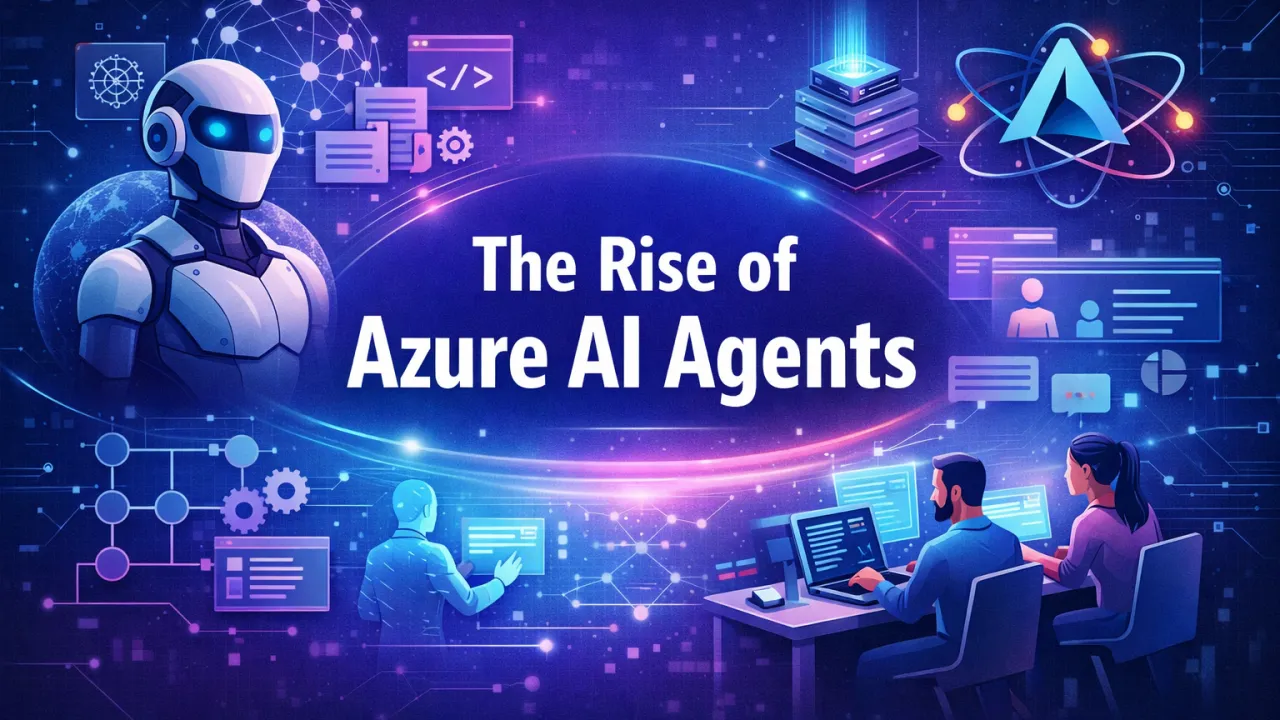
The rise of Azure AI Agents marks a turning point in application development. Intelligence is no longer an add-on feature—it is becoming a core architectural component.
By leveraging Azure’s AI ecosystem, developers can build applications that don’t just respond to users but actively work on their behalf. In an era where efficiency, personalization, and automation define success, Azure AI Agents provide the foundation for the next generation of intelligent software.