

In today’s fast-evolving software landscape, change is the only constant. Business rules evolve, features expand, and integrations grow more complex over time. One of the key reasons well-designed C# applications can adapt to these changes smoothly is polymorphism.
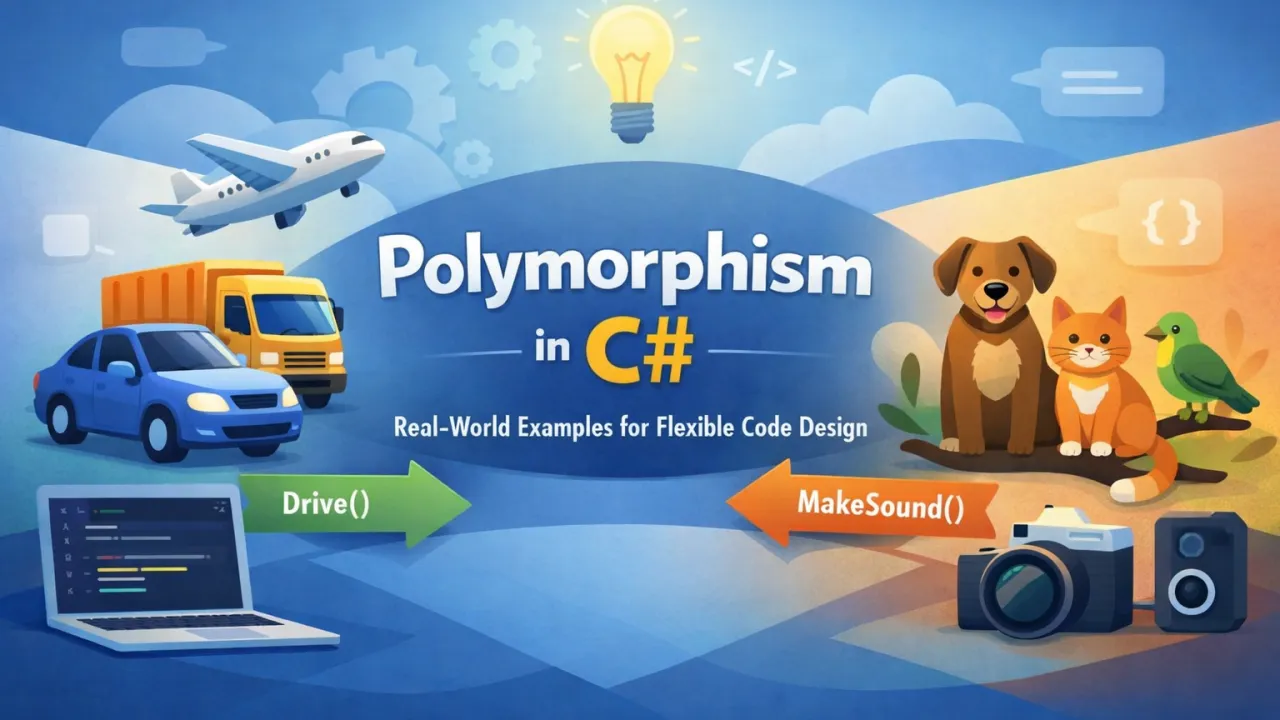
Polymorphism is not just an academic Object-Oriented Programming (OOP) concept—it is a practical design principle that helps developers write flexible, extensible, and maintainable .NET applications.
Understanding Polymorphism (Without Jargon)
At its core, polymorphism means:
One common contract, multiple behaviors.
In a C# application, this allows different objects to respond differently to the same action, while the calling code remains unchanged. The system focuses on what needs to be done, not how it is done internally.
This separation is what makes software resilient to change.
Why Polymorphism Matters in Real Applications
Without polymorphism:
- Code becomes tightly coupled
- Conditional logic keeps growing
- Small changes ripple across the system
With polymorphism:
- New features fit naturally into existing designs
- Code becomes easier to read and reason about
- Maintenance effort reduces significantly over time
Real-World Scenario 1: Payment Processing
Consider an application that supports multiple payment methods—credit cards, UPI, wallets, or net banking. From a user’s perspective, the action is simple: make a payment. Internally, however, each payment method follows a different process.
Polymorphism allows the application to treat all payment methods uniformly while letting each method handle its own rules. When a new payment option is added, existing logic remains untouched.
Result: cleaner design, safer changes, and easier expansion.
Real-World Scenario 2: Notification Systems
Modern applications notify users through various channels—email, SMS, push notifications, or in-app alerts. While the delivery mechanism changes, the intention does not.
Using polymorphism, the system sends notifications without knowing how they are delivered. Each channel implements its own behavior behind a shared abstraction.
Result: new notification channels can be added without rewriting the notification workflow.
Real-World Scenario 3: Reporting & File Exports
Users often want the same data in different formats such as PDF, Excel, or CSV. The reporting logic stays the same; only the output format differs.
Polymorphism enables the application to generate reports consistently while delegating formatting responsibilities to specialized components.
Result: strong separation of concerns and easy support for new formats.
Interfaces, Abstract Classes, and Virtual Behavior
Polymorphism in C# commonly appears through:
- Interfaces – when behavior matters more than implementation
- Abstract classes – when shared structure and default behavior are needed
- Virtual behavior – when base functionality needs controlled customization
Each approach supports dynamic behavior while keeping the system loosely coupled.
Runtime Flexibility: The Real Power
One of the strongest benefits of polymorphism is that behavior can be decided at runtime. This is especially valuable in:
- Large enterprise systems
- Plugin-based architectures
- Rule-driven or configurable applications
The application adapts without requiring invasive code changes.
Maintainability and Long-Term Benefits
Well-applied polymorphism leads to:
- Fewer conditional branches
- Cleaner and more readable logic
- Easier testing and mocking
- Lower risk during enhancements
It supports designs that grow with the business, not against it.
Final Thoughts
Polymorphism is not about complexity—it’s about clarity and adaptability. When used thoughtfully in C#, it enables systems to remain flexible, scalable, and maintainable even as requirements change.
For developers aiming to build robust .NET applications, mastering polymorphism is not optional—it’s foundational.