

In the evolving world of cloud computing, organizations are shifting away from traditional infrastructure management toward serverless architectures. The promise of serverless computing is simple yet transformative: write your application logic, deploy it, and let the cloud handle scaling, availability, and infrastructure provisioning.
For .NET developers, Azure Functions offers a seamless entry point into serverless development—combining the flexibility of event-driven architecture with the robustness and familiarity of the .NET ecosystem.
🚀 Key Benefits of Azure Functions for .NET Developers
1. Pay-as-you-go, Event-Driven Scalability
Unlike monolithic applications that run continuously, Azure Functions execute only when triggered. You’re charged solely for the time and resources consumed during execution.
- Cost efficiency: Ideal for workloads that have unpredictable or sporadic demand.
- Practical use cases: Background processing (e.g., image resizing, file parsing), scheduled tasks, IoT data ingestion, and API request handling.
- Elastic scaling: Automatically scales up during traffic spikes and scales down to zero when idle—without manual configuration.
2. Deep Integration with .NET 8 and C# 12
Azure Functions offers first-class support for the latest .NET runtime and language features, allowing developers to work with familiar syntax, frameworks, and tooling.
- Language features: Leverage records, pattern matching, and enhancements from C# 12 for concise, maintainable code.
- Dependency injection: Built-in support for DI patterns makes it easy to reuse services and components across multiple functions.
- Migration potential: Existing .NET libraries can be adapted for Azure Functions with minimal changes, reducing rework.
3. Rich Trigger and Binding Ecosystem
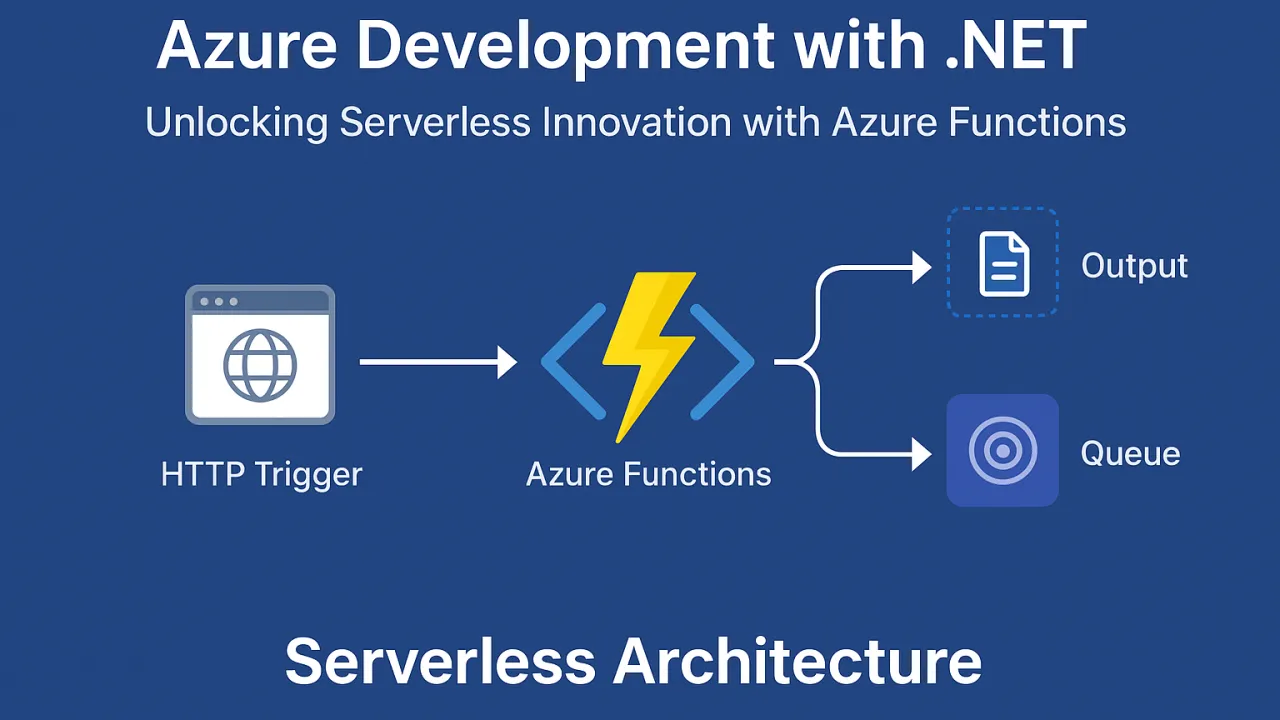
One of the most powerful aspects of Azure Functions is its integration with other Azure services through triggers and bindings.
- Triggers: Automatically start execution based on events—such as an HTTP request, a message in a queue, a new blob in storage, or a timer schedule.
- Bindings: Simplify input and output operations by abstracting away connection code, allowing you to read from and write to Azure services with minimal boilerplate.
- Supported services: Azure Blob Storage, Azure Queue Storage, Cosmos DB, Service Bus, Event Grid, Event Hubs, SQL Database, and more.
🏁 The Serverless Advantage
Serverless architecture with Azure Functions offers more than just cost savings—it transforms how applications are designed and maintained:
- Infrastructure-free development: No need to provision or patch servers; Azure manages the runtime environment.
- Faster release cycles: Teams can focus purely on business logic, reducing operational dependencies.
- Automatic scaling: Scale instantly to meet demand, then return to zero when idle, maximizing efficiency.
- Global reach: Functions can be deployed to multiple Azure regions for low-latency, high-availability access worldwide.
- Event-driven flexibility: Ideal for modern microservices and reactive architectures.
📌 Final Thoughts
Azure Functions combined with .NET unlocks a new level of agility for developers. It empowers teams to build scalable, event-driven, and cost-effective applications without the complexities of traditional infrastructure. By leveraging deep integration with the Azure ecosystem, developers can connect services, process data, and deliver features faster—while still writing in a language and framework they know best.
Whether it’s processing millions of events, integrating with cloud databases, or running scheduled tasks, serverless .NET applications with Azure Functions provide a future-ready architecture that can evolve with your business needs.