

In today’s software world, releasing code quickly is no longer enough. What truly matters is how reliably, securely, and repeatably you can move software from development to production.
As applications grow in complexity—with multiple environments, APIs, microservices, and third-party integrations—manual deployment processes become a bottleneck. They increase the risk of downtime, misconfigurations, and inconsistent environments.
This is why Continuous Integration and Continuous Deployment (CI/CD) on Azure is now the backbone of modern application delivery. A well-architected Azure CI/CD pipeline does far more than just “push code”: it creates a resilient, automated, and observable delivery process that supports both technical scalability and business agility.
🚀 Core Strategies for Azure CI/CD Pipelines
1. Multi-Stage Pipelines (Dev → Test → Prod)
The first principle of modern deployments is structured promotion across environments. Instead of pushing code directly into production, pipelines should flow through:
- Development – where code is built and validated.
- Testing / QA – where integration, regression, and performance testing happen.
- Production – where only stable, approved builds are deployed.
Each stage should include gates (like automated tests, manual approvals, or compliance checks) to ensure quality. 👉 This prevents untested code from ever reaching end-users and gives teams confidence in every release.
2. Automated Rollbacks with Deployment Slots
Even with the best testing, failures can and do occur. Instead of scrambling with hotfixes, Azure’s deployment slots allow for blue-green deployments or canary releases.
- Deploy the new version into a staging slot.
- Run health checks and smoke tests before swapping.
- If issues are detected post-swap, rollback instantly to the stable version.
👉 This means downtime is minimized, and end-users are rarely exposed to critical errors.
3. Environment Variables & Feature Flags
One of the most common mistakes in deployments is hardcoding environment-specific values. Azure offers tools like App Configuration and Key Vault to securely manage settings across environments.
- A single codebase can adapt to Dev, Test, and Prod using environment variables.
- Feature flags allow teams to control functionality dynamically:
👉 This approach makes deployments safer, more flexible, and faster to recover from mistakes.
4. Testing Gates: Building Quality In
Modern CI/CD pipelines are not just about speed—they’re about building quality assurance into every step. Before any code is promoted, it should pass through automated testing gates:
- Unit Tests – Validate individual functions and methods.
- Integration Tests – Ensure services, APIs, and databases communicate correctly.
- Security Scans – Identify vulnerabilities early (e.g., dependency scanning, OWASP checks).
- Performance Tests (optional) – Catch scaling issues before production traffic hits.
👉 These gates act as a safety net, reducing the chances of defects slipping into production.
5. Monitoring Hooks & Observability
Deployment doesn’t end when code goes live—it continues with monitoring and feedback loops.
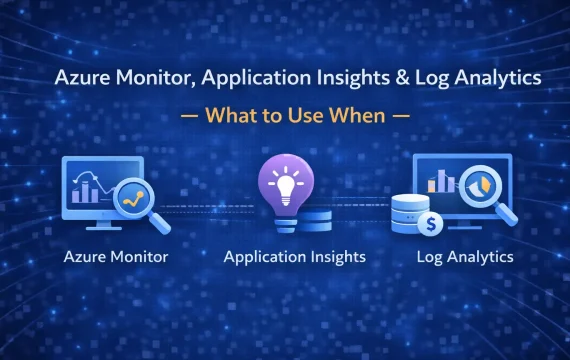
Integrating Azure Monitor and Application Insights into the pipeline gives teams real-time visibility into:
- Deployment success/failure rates
- Application health metrics (response times, error rates)
- User impact during or after deployments
Advanced setups can even halt rollouts automatically if metrics degrade, preventing widespread outages.
👉 This transforms deployments from risky “big bang” events into predictable, observable processes.
🏁 Why CI/CD is the Foundation of Modern Software Delivery
Without CI/CD:
- Releases are manual, inconsistent, and risky.
- Teams face downtime, missed deadlines, and higher operational costs.
- Business agility is lost because software updates take too long.
With CI/CD:
- Releases are fast, repeatable, and safe.
- Failures are handled gracefully through automation and rollback.
- Teams can focus on building features instead of firefighting deployments.
- Businesses achieve faster time-to-market while maintaining quality.
In short: CI/CD pipelines are not just a DevOps practice—they are a business enabler.