

Modern applications demand real-time responsiveness, scalability, and resilience. Traditional request-response models often struggle under unpredictable workloads. That’s where event-driven architecture (EDA) shines — enabling systems to react instantly to business events.
Azure provides a powerful ecosystem for building and managing event-driven solutions that scale seamlessly with demand.
🔹 What is Event-Driven Architecture (EDA)?
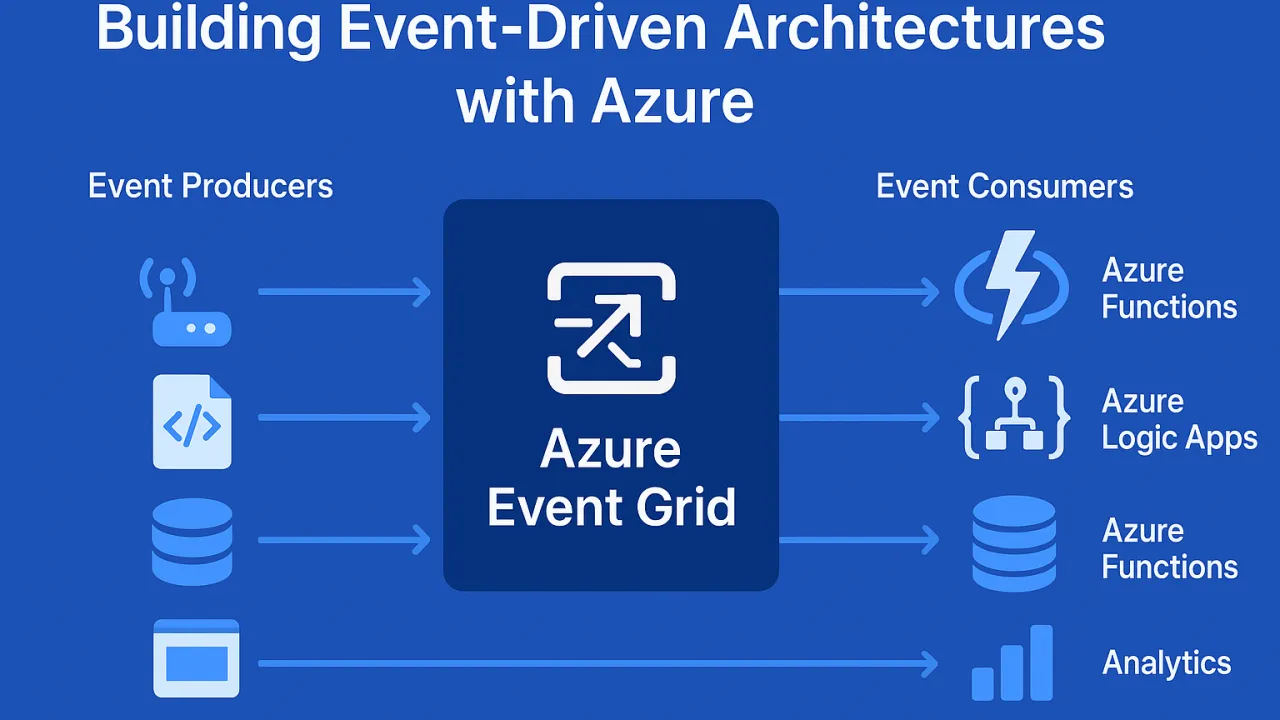
EDA is a design pattern where applications produce and consume events asynchronously. Instead of tightly coupling services, events act as a communication bridge across systems.
- Producers (emitters): Applications, IoT devices, APIs that generate events.
- Consumers (subscribers): Services that listen and respond to these events.
- Event brokers/routers: Middleware that delivers events reliably (Azure Event Grid, Service Bus, etc.).
🔹 Benefits of Event-Driven Systems with Azure
- Scalability – Applications scale on demand when events occur.
- Resilience – Services remain loosely coupled; failure in one doesn’t bring down the system.
- Real-Time Insights – Process data streams instantly (IoT, logs, financial transactions).
- Cost-Efficiency – Pay only for execution when events are triggered (serverless).
- Flexibility – Supports multiple event sources: apps, Azure resources, SaaS apps, custom systems.
🔹 Azure Services for Event-Driven Architectures
- Azure Event Grid – Central event routing service with low latency and massive throughput.
- Azure Service Bus – Enterprise messaging for complex workflows with ordered delivery.
- Azure Event Hubs – High-volume event ingestion (IoT, telemetry, streaming).
- Azure Functions – Serverless compute that reacts to events instantly.
- Azure Logic Apps – Low-code workflows triggered by events.
🔹 Real-World Use Cases
- IoT Applications: Devices sending telemetry → Azure Event Hub → Real-time analytics.
- E-commerce: Order placed → Event Grid notifies → Inventory update, payment, shipping workflows.
- Financial Services: Fraud detection triggered by unusual transaction events.
- DevOps: Event-driven CI/CD pipelines based on repo changes.
🔹 Best Practices for Azure Event-Driven Systems
- Use dead-letter queues to handle failed event deliveries.
- Optimize event schema to ensure lightweight payloads.
- Employ event versioning to avoid breaking consumers.
- Choose the right broker (Event Grid vs Service Bus vs Event Hub) based on scenario.
- Secure events with Azure AD authentication and role-based access control.
🔹 Conclusion
Event-driven architectures unlock real-time, scalable, and fault-tolerant applications. With Azure’s ecosystem — Event Grid, Event Hubs, Service Bus, and Functions — developers can build responsive systems that handle millions of events seamlessly.
The future of cloud-native applications is event-driven — and Azure makes it possible at scale.