

When many developers first encounter Azure Functions, the use cases seem simple: run some code when a blob is uploaded, a queue message arrives, or a scheduled job executes. These basic triggers are powerful in their own right, but Azure Functions have evolved far beyond simple event handling.
Modern cloud applications require complex orchestration, high-performance processing, intelligent integrations, and scalability—and Azure Functions now deliver all of this while retaining their serverless simplicity.
In this deep dive, we explore advanced patterns that push Azure Functions into enterprise-grade, production-ready architectures.
🚀 Advanced Scenarios in Azure Functions
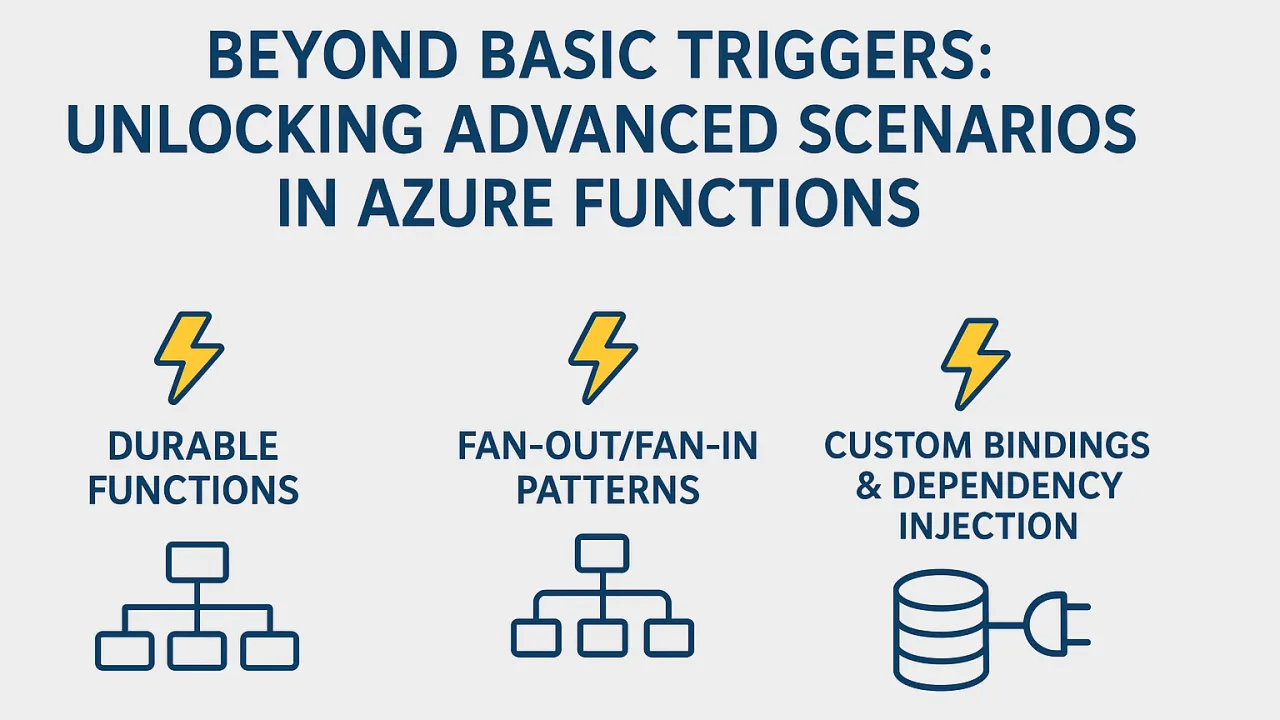
1. Durable Functions – Stateful Orchestration at Scale
The Challenge: Traditional serverless functions are stateless and short-lived, which can make it hard to handle workflows that span minutes, hours, or even days.
The Solution: Durable Functions extend Azure Functions with orchestration capabilities that maintain state across multiple function executions.
Key Features:
- Long-running workflows: Handle approval chains, multi-step batch jobs, or order processing pipelines without manual state management.
- Checkpointing: Automatically save the state of an execution and resume later without re-processing previous steps.
- Multiple patterns:
Example: A loan approval system that:
- Collects application data.
- Runs multiple checks in parallel (credit score, fraud detection, document validation).
- Waits for manual review if flagged.
- Proceeds to approval or rejection.
2. Fan-out/Fan-in Patterns – Massive Parallelism for Data Processing
The Challenge: Processing large datasets or high-volume tasks sequentially can be too slow.
The Solution: The Fan-out/Fan-in pattern allows you to:
- Break large workloads into smaller, independent tasks.
- Process them in parallel across multiple function instances.
- Aggregate results when all tasks complete.
Benefits:
- Scalability: Azure automatically provisions additional compute resources.
- Performance: Large-scale processing is significantly faster.
- Cost efficiency: You only pay for compute while tasks are running.
Example: An image-processing pipeline that:
- Detects when a batch of product images is uploaded.
- Fans out to resize and watermark each image in parallel.
- Fans in to update a database with processed image URLs.
3. Custom Bindings & Dependency Injection – Extending Serverless Capabilities
The Challenge: Out-of-the-box triggers and bindings are powerful, but some scenarios require integration with custom services or APIs.
The Solution:
- Custom Bindings: Create new input/output bindings for services that Azure doesn’t natively support.
- Dependency Injection (DI): Use DI to share services across functions, keep code modular, and reduce duplication.
Advantages:
- Clean separation of concerns.
- Easy testing and maintenance.
- Reusability across multiple functions and projects.
Example: A set of Azure Functions that integrate with a proprietary ERP system using a custom binding for data retrieval and DI for shared authentication services.
🏁 Beyond “Simple” Serverless
The perception that serverless functions are only for quick, stateless scripts is outdated. With advanced features, Azure Functions can:
- Orchestrate complex business workflows with durable state.
- Process massive workloads using distributed, parallel execution.
- Integrate with virtually any system through custom bindings and DI.
- Run intelligent pipelines by incorporating AI/ML models into processing stages.
- Connect to IoT ecosystems for real-time data ingestion and analytics.
📌 Final Thoughts
Azure Functions have grown from simple event handlers into a full-fledged application platform for cloud-native development. By leveraging advanced scenarios like Durable Functions, Fan-out/Fan-in patterns, and Custom Bindings, development teams can build intelligent, scalable, and maintainable solutions—all while enjoying the agility and cost-efficiency of serverless computing.
Serverless today isn’t just about “less ops”—it’s about more possibilities.