

Modern distributed systems rarely operate in isolation. Most applications rely on external services, third-party APIs, databases, and microservices to deliver functionality. While this architecture increases flexibility and scalability, it also introduces a new challenge: network and service failures are inevitable.
Temporary outages, slow responses, or overloaded services can cascade across systems and bring down entire applications if not handled properly.
This is where resilience patterns like Retry Policies and Circuit Breakers become essential. These patterns allow .NET applications to gracefully handle failures, maintain stability, and protect downstream services.
Why Resilience Matters in Modern Applications
In distributed architectures, failures are not exceptions — they are normal operating conditions.
Examples include:
- Temporary network interruptions
- External APIs returning intermittent errors
- Services becoming overloaded
- Database latency spikes
- Cloud infrastructure hiccups
Without resilience mechanisms, applications may repeatedly attempt failing operations, amplifying the problem and overwhelming dependent systems.
Circuit breakers and retry policies help prevent this by controlling how applications respond to failures.
Understanding Retry Policies
A retry policy automatically retries failed operations when errors occur. This is particularly useful for transient failures, which are temporary issues that often resolve themselves quickly.
Examples of transient errors include:
- Temporary network disconnections
- Service timeouts
- Rate-limited requests
- Temporary database locks
Instead of immediately failing a request, the application waits briefly and attempts the operation again.
When Retry Policies Are Useful
Retry strategies are effective when failures are temporary and recoverable.
Common use cases include:
- Calling external APIs
- Communicating with microservices
- Accessing cloud resources
- Database operations during transient load spikes
Best Practices for Retry Policies
Retry logic should be implemented carefully to avoid causing additional problems.
Key practices include:
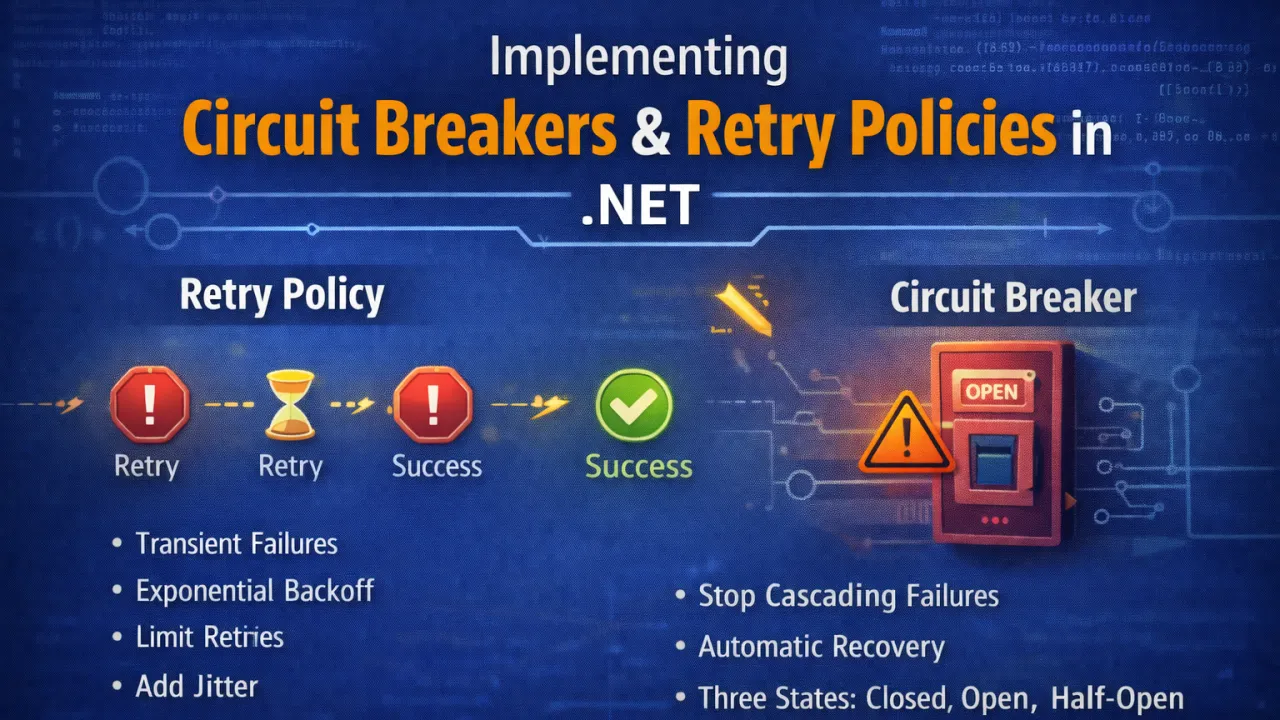
Use Exponential Backoff Each retry waits longer than the previous one to avoid overwhelming the system.
Limit Retry Attempts Avoid infinite retries that could exhaust system resources.
Add Jitter Random delays prevent multiple services from retrying simultaneously.
Retry Only for Transient Errors Permanent errors (such as invalid requests) should not trigger retries.
Understanding the Circuit Breaker Pattern
While retry policies handle temporary failures, they can worsen problems if the service being called is completely unavailable.
This is where the Circuit Breaker pattern becomes critical.
A circuit breaker acts like an electrical circuit breaker:
- If too many failures occur, the circuit opens.
- While open, requests fail immediately instead of attempting the call.
- After a cooldown period, the circuit enters a half-open state to test whether the service has recovered.
The Three States of a Circuit Breaker
Closed State Requests flow normally. Failures are monitored.
Open State Requests are blocked temporarily to prevent further stress on the failing service.
Half-Open State A limited number of test requests determine whether the service has recovered.
If successful, the circuit closes again. If failures continue, it reopens.
Why Circuit Breakers Are Important
Without a circuit breaker:
- Services continuously retry failing requests
- System resources are wasted
- Failures cascade across services
- Recovery becomes slower
Circuit breakers protect both your application and the services it depends on.
Implementing Resilience in .NET with Polly
In the .NET ecosystem, the most widely used library for resilience policies is Polly.
Polly provides support for:
- Retry policies
- Circuit breakers
- Timeout policies
- Bulkhead isolation
- Fallback strategies
Polly integrates seamlessly with HttpClientFactory in ASP.NET Core, making it easy to apply resilience policies to outgoing HTTP calls.
Example concept:
Retry → Wait → Retry again → Circuit opens if failures persist
With Polly, developers can configure retry attempts, backoff strategies, and circuit breaker thresholds with minimal effort.
Combining Retry and Circuit Breaker Policies
Retry and circuit breaker patterns work best when used together.
A typical strategy might look like this:
- Retry a request a few times for transient failures.
- If repeated failures occur, open the circuit breaker.
- Temporarily stop sending requests.
- Periodically test if the service has recovered.
This approach prevents systems from repeatedly hitting a failing dependency.
Additional Resilience Techniques
Circuit breakers and retries are part of a broader resilience toolkit.
Other useful strategies include:
Timeout Policies Prevent requests from waiting indefinitely.
Bulkhead Isolation Limit resource usage to prevent one failing component from affecting others.
Fallback Mechanisms Provide alternative responses when services fail.
Rate Limiting Protect systems from overload during traffic spikes.
Observability and Monitoring
Resilience patterns are only effective when combined with strong monitoring and observability.
Teams should monitor:
- Retry counts
- Circuit breaker states
- External service response times
- Failure rates
Tools such as Application Insights, Prometheus, Grafana, and OpenTelemetry provide valuable insights into system behavior.
Monitoring ensures teams know when circuit breakers activate and why failures occur.
Key Lessons for Building Resilient .NET Applications
To implement effective resilience strategies:
- Use retry policies for transient failures • Apply circuit breakers to prevent cascading failures • Combine retries with exponential backoff and jitter • Limit retry attempts to avoid resource exhaustion • Monitor circuit breaker behavior with observability tools • Protect critical resources with bulkhead isolation
Final Thoughts
In distributed systems, failures are not rare events — they are expected conditions.
Applications that assume everything will always work eventually face cascading failures and system outages.
By implementing retry policies and circuit breakers, .NET applications become more resilient, stable, and capable of handling real-world conditions.
These patterns don’t eliminate failures — but they ensure failures don’t bring down the entire system.
Resilience is no longer optional. It’s a fundamental requirement for modern, scalable software architectures.