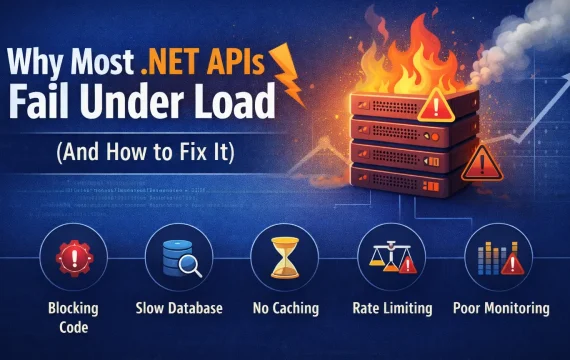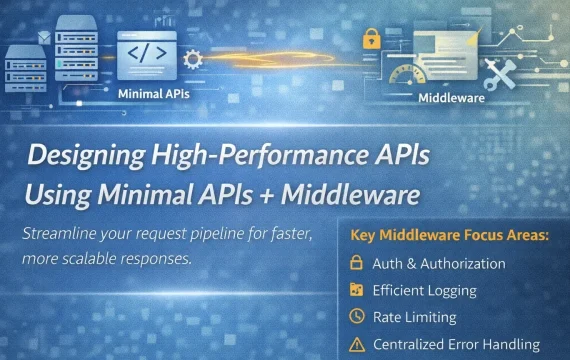


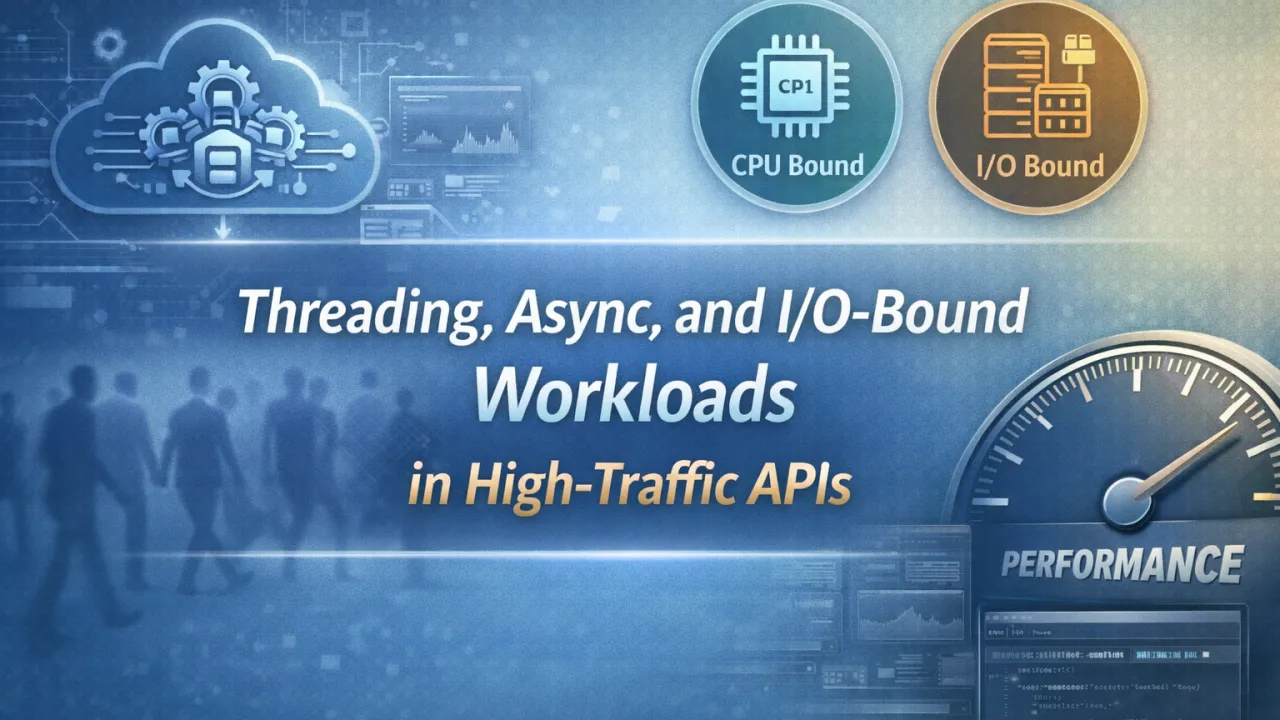
High-traffic APIs don’t fail because of lack of features. They fail because of poor thread management.When traffic increases, the real bottleneck is rarely business logic. It’s how your application handles threads, asynchronous operations, and I/O-bound workloads.Understanding this difference is what separates scalable APIs from systems that collapse under load.
The Hidden Problem: Thread Starvation
In high-traffic environments, every incoming request needs processing capacity. In traditional blocking models, each request occupies a thread until the work completes. If that work includes database calls, HTTP calls, file access, or external services, the thread remains blocked while waiting.
Now multiply that by thousands of concurrent users.
Eventually:
- The thread pool gets exhausted
- Requests queue up
- Latency spikes
- Throughput drops
This is thread starvation — and it silently kills performance.
CPU-Bound vs I/O-Bound Workloads
Not all workloads are equal.
CPU-bound work consumes processor time. Examples include:
- Complex calculations
- Data transformations
- Encryption
- Image processing
I/O-bound work waits for external operations:
- Database queries
- API calls
- File system access
- Network requests
Most high-traffic APIs are primarily I/O-bound, not CPU-bound.
And that changes everything.
Why Async Matters
For I/O-bound workloads, blocking threads is wasteful. While waiting for a database response, the CPU is idle — but the thread is occupied.
Asynchronous programming allows:
- Threads to be released while waiting
- Better thread pool utilization
- Higher request throughput
- Improved scalability
Async/await is not just syntactic sugar. It’s a scalability tool.
When implemented correctly, asynchronous APIs can handle significantly more concurrent requests without increasing hardware resources.
Common Mistakes in High-Traffic APIs
Even with async support, performance can suffer due to:
- Using .Result or .Wait() (sync-over-async)
- Blocking calls inside async methods
- Overusing Task.Run unnecessarily
- Poor connection pooling
- Not configuring thread pool settings appropriately
These mistakes reintroduce blocking behavior and reduce scalability.
Designing for High Traffic
If your API handles large volumes of traffic, focus on:
- Making database and HTTP calls fully asynchronous
- Avoiding long-running CPU work on request threads
- Offloading heavy processing to background services
- Monitoring thread pool utilization
- Measuring request latency under load
Performance should be validated under stress — not assumed.
The Real Goal
High-traffic APIs aren’t about just handling more users. They’re about handling more users efficiently.
Threading and async patterns directly impact:
- Throughput
- Latency
- Resource consumption
- Infrastructure cost
In modern backend systems, scalability is not achieved by adding servers. It’s achieved by designing for non-blocking I/O and efficient thread usage.