

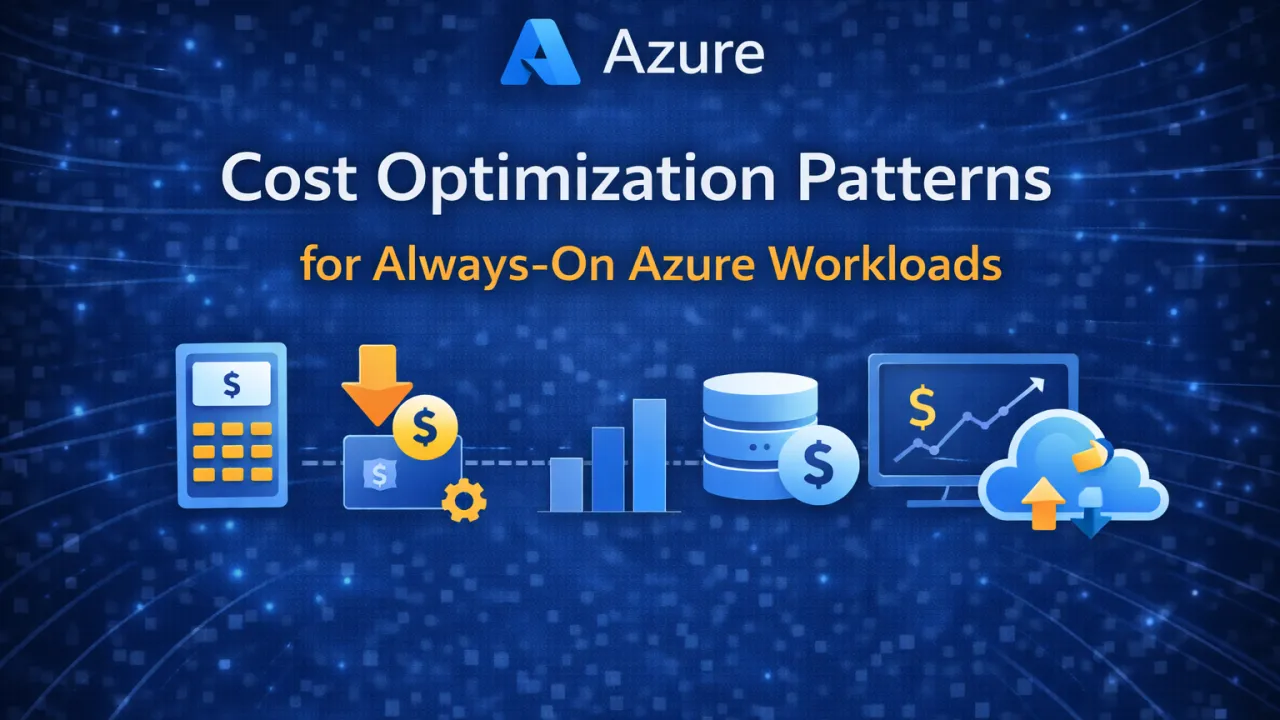
In cloud systems, performance and scalability often get the most attention. But there’s another factor that directly impacts long-term success — cost.
Always-on workloads — APIs, background services, microservices, and core business systems — run 24/7. That means even small inefficiencies compound into significant monthly expenses.
Cost optimization in Azure is not about cutting corners. It’s about designing efficiently from the start.
The Hidden Problem
Many systems are deployed with a “just make it work” mindset:
- Over-provisioned resources • Idle compute running continuously • Unoptimized scaling rules • Paying for peak capacity even during low usage
These decisions don’t hurt immediately — but over time, they quietly increase cloud bills.
Right-Sizing Resources
One of the simplest and most effective strategies:
Match resources to actual usage.
- Avoid oversized App Service plans or VMs • Monitor CPU, memory, and request patterns • Continuously adjust based on real data
Over-provisioning is one of the most common cost leaks.
Use Autoscaling Intelligently
Always-on doesn’t mean always at peak capacity.
Best practices:
- Scale out during high traffic • Scale in during low usage • Use metrics like CPU, requests, or queue length • Avoid aggressive scaling that increases churn
Smart scaling reduces cost without impacting performance.
Choose the Right Compute Model
Different Azure services have different cost models:
- App Service → predictable but always running • Container Apps → can scale dynamically • AKS → flexible but operationally expensive • Serverless options → cost-effective for variable workloads
Choosing the wrong platform can significantly increase costs.
Optimize Background Processing
Background jobs often run inefficiently.
Common issues:
- Polling too frequently • Long-running idle processes • Unnecessary compute usage
Better approach:
- Use event-driven models (queues, triggers) • Process work only when needed • Reduce idle cycles
Storage and Data Costs
Storage is often overlooked but adds up quickly.
Optimize by:
- Using appropriate storage tiers (Hot, Cool, Archive) • Cleaning unused data regularly • Avoiding redundant storage patterns • Compressing large datasets where possible
Network and Data Transfer Costs
Data transfer between regions or services can increase costs.
Best practices:
- Keep services in the same region when possible • Minimize cross-region traffic • Optimize API calls and payload sizes
Observability for Cost
You can’t optimize what you don’t measure.
Track:
- Resource utilization • Cost per service • Cost per request • Idle vs active usage
Azure Cost Management tools provide visibility into spending patterns.
The Real Insight
Cost optimization is not a one-time task. It is a continuous engineering practice.
Efficient systems are:
- Right-sized • Dynamically scaled • Event-driven • Observed and adjusted regularly
The goal is not to spend less — it’s to spend smarter.
Final Thought
Always-on workloads don’t have to mean always-expensive systems.
The difference lies in how intentionally they are designed.
If you're running Azure workloads 24/7, are you optimizing for performance only — or balancing it with cost efficiency?