

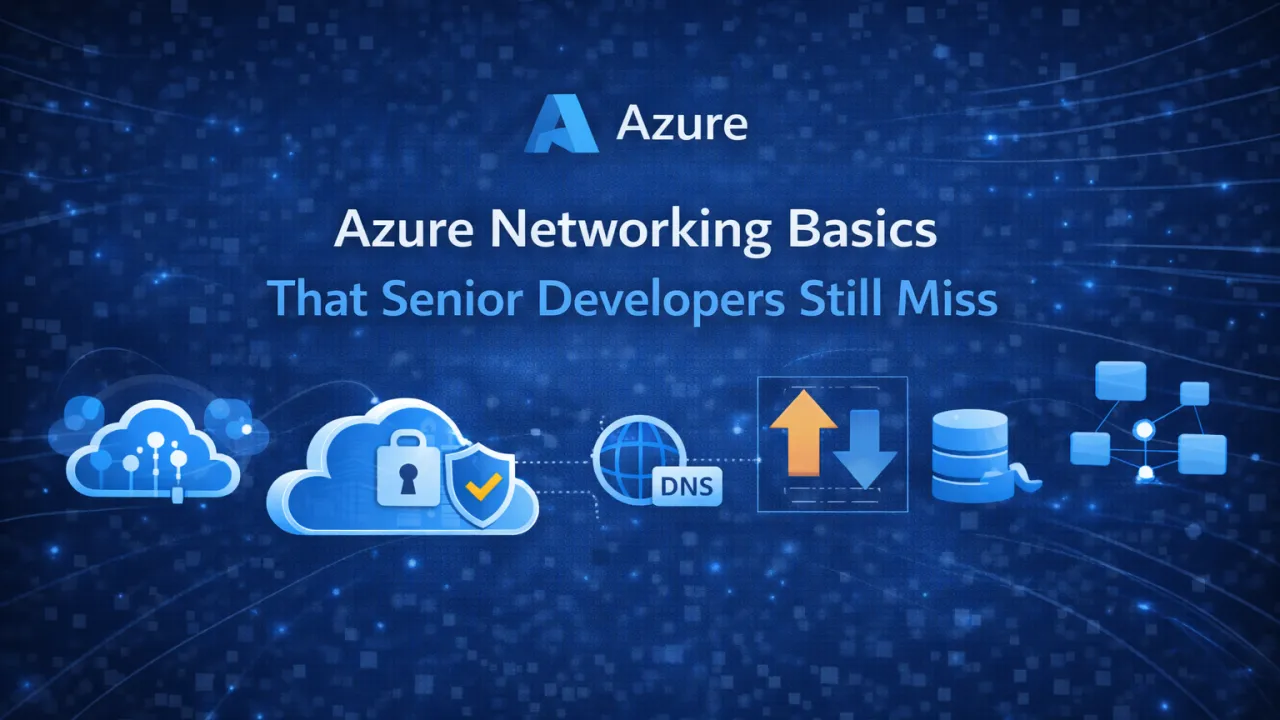
Cloud networking is often treated as “someone else’s responsibility.” Developers focus on code. DevOps focuses on infrastructure.
But in modern cloud systems, that separation no longer works.
Many production issues — latency, timeouts, security gaps, unexpected failures — are not caused by code. They are caused by networking misunderstandings.
And surprisingly, even experienced developers miss some of the basics.
The Illusion of “It Just Works”
Azure makes networking look simple:
- Deploy an App Service • Connect to a database • Call another API
Everything works — until it doesn’t.
Behind the scenes, networking decisions impact:
- Performance • Security • Reliability • Cost
Ignoring them leads to fragile systems.
Virtual Network (VNet) Is Not Optional
Many developers assume VNets are only needed for complex setups.
That’s a mistake.
A Virtual Network (VNet) defines how your resources communicate securely within Azure.
Without proper VNet design:
- Services may be exposed publicly • Internal communication becomes insecure • Network isolation is lost
Even simple systems benefit from proper VNet planning.
Public vs Private Access – A Critical Choice
One of the most common mistakes:
Leaving services publicly accessible by default.
Azure services often expose public endpoints unless configured otherwise.
Best practice:
- Use private endpoints for internal communication • Restrict public access wherever possible • Control traffic using NSGs (Network Security Groups)
Security in cloud starts with network boundaries.
Latency Is a Network Problem
Developers often optimize code when facing performance issues.
But many times, the real issue is:
- Cross-region communication • Unoptimized routing • Excessive network hops
Simple improvements like placing services in the same region or using proper routing can drastically reduce latency.
DNS and Service Discovery Matter
In distributed systems, services need to find each other.
Misconfigured DNS leads to:
- Failed connections • Intermittent issues • Hard-to-debug production problems
Understanding how Azure handles DNS — especially with private endpoints and VNets — is essential.
Outbound Connectivity Is Often Ignored
Most focus on incoming traffic, but outbound connectivity is equally important.
Questions developers rarely ask:
- How does my app call external services? • Is outbound traffic secured? • Are IPs predictable for whitelisting?
Ignoring outbound flow can break integrations and create security risks.
Network Security Groups (NSGs) Are Your First Firewall
NSGs control traffic at subnet and resource levels.
They define:
- Who can access what • Which ports are open • What traffic is allowed or denied
Misconfigured NSGs can either:
- Block critical communication • Or expose services unintentionally
The Real Problem
The issue is not lack of tools. Azure provides everything needed.
The issue is mindset.
Networking is often treated as: “Set it once and forget it.”
In reality, networking is part of application design.
The Real Insight
Senior developers don’t need to become network engineers.
But they must understand:
- How services communicate • Where data flows • What is exposed publicly • What affects latency
Because in the cloud, architecture is not just code — it’s code + network + infrastructure working together.